💡 TLDR: Strategic cargo theft is surging in 2026 because thieves now steal by deception instead of force. They pose as legitimate carriers, alter paperwork and collect high-value freight at the dock. Reported thefts are down, but losses are up 39%. The defense is to verify the carrier, the driver and the truck before the load is released.
On Aug. 29, a truck collected six pallets of NVIDIA computer hardware in Oakland, California, for delivery to Fort Worth, Texas. It wore the logo of a food transportation company, The Mercury News reported. Investigators reportedly tracked it through several extended stops before losing its trail in Southern California, according to FreightWaves. The load was reportedly worth $11.4 million. Police have announced no arrests and have not confirmed any recovery.
Police have not confirmed the value or identified the merchandise, and investigators have not established whether anyone impersonated a transportation provider. The data around the case is less ambiguous. Cargo thieves are striking less often and taking far more when they do, and fraud is increasingly how they get the freight.
Why is strategic cargo theft surging even as total incidents drop?
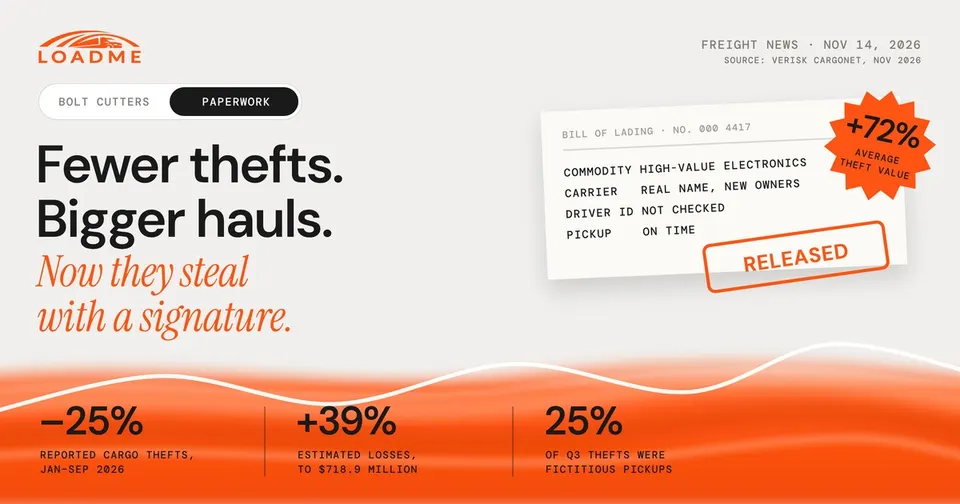
Because thieves have moved to more valuable freight. Verisk CargoNet, which tracks the U.S. and Canada, counted 2,072 reported supply chain crime incidents through September, down 25% from 2,755 a year earlier. Estimated losses rose 39% over the same period, to $718.9 million. Among thefts with a documented value, the average climbed about 72%, to $448,456.
The third quarter shows how the mix has changed. Thefts of $1 million or more rose to 19 from nine. Fictitious pickups, in which a thief uses deception to collect a shipment, held nearly steady at 138 while other crime fell, so their share of reported incidents grew to about 25% from 18%. California, New Jersey, Texas and Illinois together accounted for 57% of the quarter's incidents.
The industry's name for this is strategic cargo theft: taking freight through fraud and identity manipulation instead of cutting a lock. The American Trucking Associations says theft that relies on cyber tactics, carrier impersonation and load board hijacking has grown more than 1,500% since 2021. The American Transportation Research Institute puts the cost to trucking as high as $6.6 billion a year, or more than $18 million a day. Across the wider supply chain, ATA says, losses may reach $35 billion annually.
Why are AI hardware and electronics the new targets?
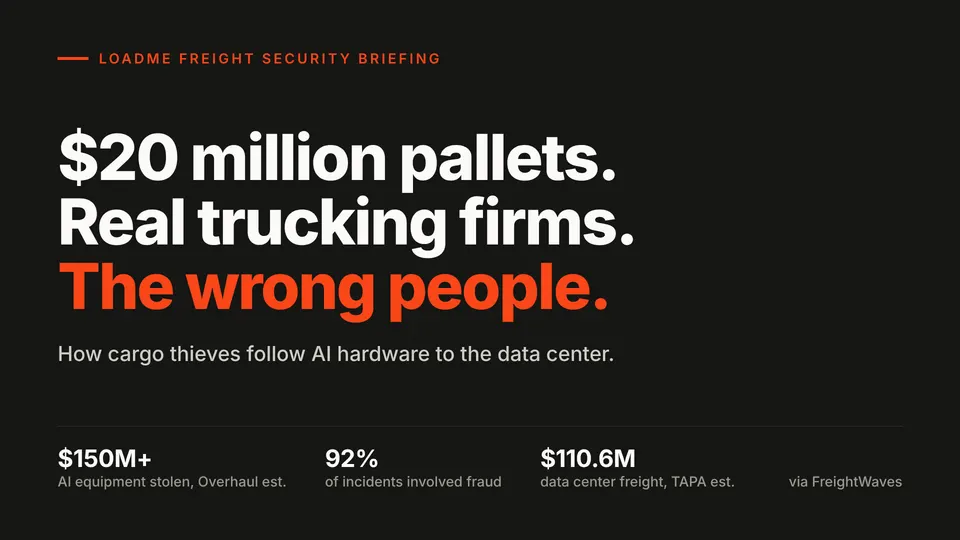
Few loads pack more value into a trailer. A single flagship AI server rack costs roughly $3 million, according to Overhaul, which sells supply chain visibility and risk management services. Overhaul estimates that more than $150 million in AI equipment was stolen in the 12 months through June 2026, FreightWaves reported on Nov. 13.
Overhaul's report analyzed 111 AI equipment thefts across the United States from 2023 through June 2026. Incidents are up 34% since 2024, according to Overhaul. In 92% of them the thieves used fraud or deception, with tactics such as identity theft, fraudulent carrier identities and altered bills of lading.
The stolen hardware is the smaller part of the bill. For every dollar covered by an insurance claim, Overhaul estimates, roughly $3 more goes unclaimed in costs that include deployment delays, lost contract eligibility, compliance exposure and added security spending. The company calls that ratio conservative.
Overhaul has a commercial stake in the subject, but Verisk's data points the same way. "Data center materials are among the valuable commodities attracting attention," said Keith Lewis, vice president of operations at Verisk CargoNet.
Why isn't GPS tracking enough to stop freight fraud?
A tracker reports where a load is. It has no way of knowing whether the right company picked it up. Barry Conlon, Overhaul's chief executive, put it this way: "As thieves become increasingly deceptive, visibility into a shipment alone isn't enough to stop it from being taken."
A federal case prosecuted in Los Angeles shows how the gap gets used. On Sept. 29, a jury found two defendants guilty of conspiracy to commit theft from interstate or foreign shipments. According to evidence at trial, the group purchased or fraudulently used real trucking companies to bid on authentic shipping contracts, took possession of the cargo and stole it. In one instance, a defendant met a Texas trucking company's owner to buy the business for about $22,000. The estimated loss was at least $2 million in televisions, laptops, appliances and other goods.
The trucking companies were real, by the government's account. What had changed was the people running them.
Small fleets carry much of this risk. Federal data cited by ATA shows almost 580,000 active U.S. motor carriers as of June 2025, and 91.5% of them operate 10 or fewer trucks. A five-truck company rarely has anyone assigned to watch for a stolen identity, and its name and authority are what a thief needs.
How can shippers and carriers prevent fictitious pickups?
Lewis says that as cargo values rise, "strong identity verification, shipment visibility and communication across the supply chain become even more important." In practice, fictitious pickup prevention comes down to five habits.
- Verify the carrier twice. Check authority and insurance when you book, then confirm at pickup that the truck at the dock belongs to the carrier you booked.
- Verify the person. Match the driver's identity and license to the name the carrier gave you before the trailer is loaded.
- Keep the chain short. Know every party between you and the truck, and do not release freight to a carrier you did not approve. This is how a double brokering scam ends with your load on a stranger's trailer.
- Treat changes as alarms. Confirm a new phone number, a different truck or an edited bill of lading through a contact you already had. Earlier this year CargoNet documented schemes built on compromised business email accounts and internet-based phone systems.
- Carriers, guard your own name. Watch your FMCSA record, secure your email and load board logins, and report anyone booking freight as you.
How does a direct freight marketplace reduce the risk?
Each of those habits gets harder as freight passes through more hands. LoadMe is a direct freight marketplace that connects shippers with vetted carriers, with no broker between them and no take rate on the freight.
| Security question | Traditional brokered load board | Verified direct freight marketplace (LoadMe) |
|---|---|---|
| Who posts the load | Often a broker, with the shipper one or more steps removed | Only shippers. Shipper and carrier contract directly |
| Carrier identity verification | Varies by board, and often stops at account-level authority and insurance checks | USDOT number checked against FMCSA records, staff review of every application, biometric identity check on the person acting for the carrier |
| Driver identity | Usually left to the broker or the dock | Drivers complete identity verification, including facial recognition, and hold a verified license |
| Double brokering risk | A load can be passed to a carrier the shipper never approved | No broker layer, and monitoring flags attempts to re-broker a load |
| ELD and GPS integration | Depends on each broker and carrier | ELD integration for live tracking, geofenced arrivals, and alerts when tracking goes quiet |
| BOL and pickup controls | Paper or emailed documents checked at the dock | Driver photographs the BOL at pickup and the signed proof of delivery in the app. Insurance is checked again on every booking |
For the more than nine in 10 carriers that run small fleets, verification works as a credential. It puts an honest five-truck operator in front of shippers' freight without a middleman, and it makes that operator's name harder for someone else to use. For shippers, it means knowing who is coming for the load before the truck arrives.
No platform can promise that fraud never gets through, and on LoadMe the shipper still chooses its carrier. Carrier identity verification changes the thief's problem. In the Los Angeles case, a trucking company's identity was on offer for about $22,000. A face, a license, a truck and an insurance policy that all match it are much harder to come by.
Frequently asked questions
What is strategic cargo theft?
Strategic cargo theft is stealing freight through fraud instead of force. Thieves impersonate legitimate carriers, use stolen or purchased trucking company identities, or alter shipping documents so the load is handed to them. ATA says this kind of theft has grown more than 1,500% since 2021.
What is a fictitious pickup?
A fictitious pickup happens when someone uses deception, such as a false carrier identity or forged paperwork, to collect a shipment and then disappears with it. Verisk CargoNet reports that fictitious pickups made up about 25% of reported supply chain crime incidents in the third quarter of 2026.
What is a double brokering scam?
A double brokering scam is when a party accepts a load and passes it to another carrier without the shipper's knowledge or approval. The shipper loses sight of who has the freight, which can end in an unpaid carrier or a stolen load.
How does carrier identity verification stop freight fraud in U.S. trucking?
It checks several things a thief has to fake at once: operating authority, active insurance, the identity of the owner and the driver, and the truck. A fraud that passes one check, such as a real company under new owners, is more likely to fail when all of them are checked together.
Sources
- AI cargo thefts top $150 million from June 2025 to June 2026, FreightWaves, Patrick Hatzis, Nov. 13, 2026
- $11.4 million in NVIDIA hardware vanishes during shipment from California to Texas, FreightWaves, Phil Brink, Nov. 9, 2026
- Fewer Cargo Thefts, Bigger Losses: Average Theft Value Jumps 72 Percent Year to Date, Verisk press release, Nov. 4, 2026
- New ATRI Research Confirms the High Costs of Cargo Theft to Industry, American Transportation Research Institute, Oct. 8, 2025
- Washington Must Put Cargo Thieves on Notice, American Trucking Associations, Chris Spear, Dec. 17, 2025
- Economics and Industry Data, American Trucking Associations
- Two Indian Nationals Found Guilty of Participating in Cargo Theft Scheme in Which Freight Was Stolen from Shippers, U.S. Attorney's Office, Central District of California, Sept. 29, 2026
Note on sourcing: figures are as published by the sources above. Overhaul's figures are reported by FreightWaves and are that company's estimates. CargoNet figures cover reported incidents in the U.S. and Canada. Descriptions of LoadMe's verification steps come from LoadMe. This article is general information, not legal or security advice.