Troopers are pulling trucks off the road with two working brakes while regulators pull logging devices off the federal registry. Both are aimed at the same carriers, and both change what a clean record is worth.
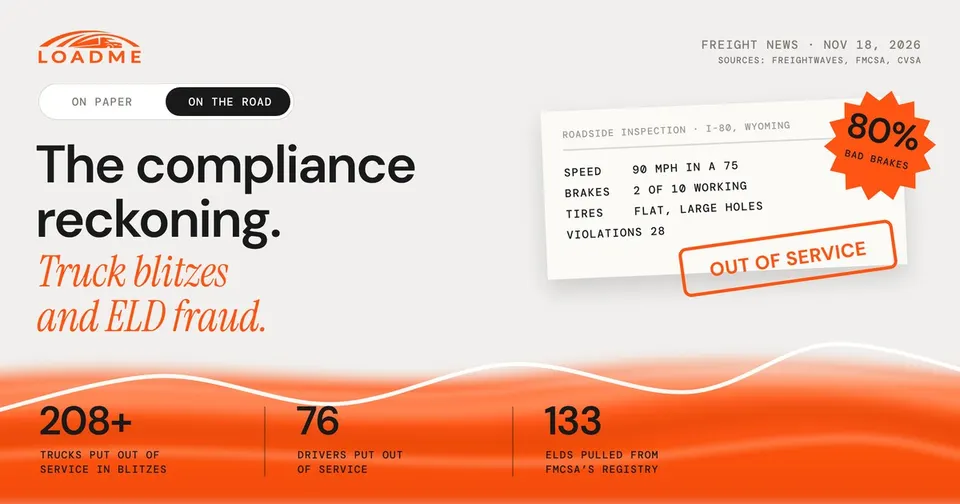
Late-2026 enforcement blitzes in more than a dozen states and two Canadian provinces put at least 208 trucks and 76 drivers out of service, while FMCSA removed 133 electronic logging devices from its registry. The American Trucking Associations now wants third-party ELD certification modeled on Canada's. Carriers face tighter checks on equipment, drivers and logs.
On Veterans Day, Wyoming Highway Patrol troopers stopped a tractor-trailer on Interstate 80 east of Laramie. It was doing 90 mph in a 75 zone. The inspection that followed turned up 28 violations. Only two of the truck and trailer's 10 brakes were functioning. One brake chamber was missing altogether, its air lines capped. Several tires were flat or had large holes in them.
The driver got a speeding ticket, and the rig was placed out of service and towed, FreightWaves reported.
A truck like that is a failure anyone can see from the shoulder. The other kind takes place on a screen. Kevin Grove, director of safety and technology policy at the American Trucking Associations, described reports of drivers who reach their legal hours and are told to call a phone number. "They can call the number, and then through wireless communication, they're able to upload new logs to the device," he told FreightWaves. The new logs show a driver with hours to spare, and the truck keeps moving.
Both problems came to a head this month. Police across North America reported the results of a run of roadside operations, and the largest trucking trade group published a plan to rebuild how electronic logging devices are approved. Read together, they describe one tightening system, and they change the math for every carrier and every shipper that hires one.
What did the late-2026 enforcement blitzes find?
FreightWaves tallied operations conducted mostly in late October and November. The agencies involved reported at least 208 commercial vehicles and 76 drivers placed out of service.
| Jurisdiction | Dates | Inspections | Violations or citations | Vehicles out of service | Drivers out of service |
|---|---|---|---|---|---|
| Indiana (State Police, Operation Guardian, Indiana results only) | Oct. 26 to 28 | 501 | 136 out-of-service violations | 85 | 51 |
| Kentucky State Police (25-county eastern region) | October | 886 | 650 | 97 | Not reported |
| Avon, Massachusetts (State Police and Avon police) | Nov. 4 | 45 | 136 | 7 | 11 |
| Montgomery Pass, Nevada (Nevada Highway Patrol) | Nov. 2 to 3 | 69 | 73 | 3 | 8 |
| Patterson, New York (Putnam County sheriff, state DOT) | Nov. 17 | 8 | 25 tickets | 3 | 4 |
| Norwalk, Connecticut (Norwalk police, DMV police) | Reported Nov. 17 | 12 | 10 citations | 1 | Not reported |
| Berthoud, Colorado (Larimer County sheriff, State Patrol) | Not stated | Not reported | 34 | 2 | 2 |
| Clearview Township, Ontario (provincial police, Ministry of Transportation) | Nov. 10 | 21 | 24 offense notices | 6 | Not reported |
| Oakwood, Ontario (Ontario Provincial Police) | Not stated | Not reported | Not reported | 2 | Not reported |
| Pincher Creek area, Alberta (community peace officers, Highway Sheriff Patrol) | Nov. 9 | More than 30 | Not reported | 2 | Not reported |
Source: agency figures as compiled by FreightWaves, Nov. 18, 2026. The operations cover different periods and methods, so the rows are not directly comparable. The Wyoming stop is not included in the totals.
The details say more than the totals. Indiana's three days were part of Operation Guardian, a coordinated push across 16 states that targeted secondary highways and bypass routes. Indiana's officers alone recorded 28 criminal arrests, and eight drivers were sidelined for English-language proficiency violations.
In Avon, officers found three drivers operating without licenses, six without medical certificates, a commercial vehicle missing brakes, and a motor carrier still operating after failing a safety audit in 2024.
How do those numbers compare with a normal inspection?
They run high, which is what a targeted operation is designed to produce.
The benchmark is the Commercial Vehicle Safety Alliance's International Roadcheck, a three-day inspection event across North America each spring. In May 2026, inspectors conducted 54,575 inspections and placed 10,350 vehicles and 3,184 drivers out of service, FleetOwner reported. Measured against all inspections, that is about 19% for vehicles and about 6% for drivers.
Indiana's officers put a vehicle out of service in 17% of their inspections and a driver in 10%. In Avon, 11 of 45 inspections ended with a driver sidelined. These are small samples chosen by police, and they are not a measure of the whole fleet. They do show what turns up when enforcement goes looking on the routes trucks use to avoid it.
Brakes lead the list every year. Brake systems were the top vehicle violation at Roadcheck, and brake categories together made up 39% of vehicle out-of-service violations. The alliance's out-of-service criteria are the pass-fail standard inspectors use, and the defective-brake rule applies when at least 20% of the brakes on a vehicle or combination have an out-of-service condition, as Truck Driver News summarized it. The truck on I-80 was at 80%.
What is ELD fraud, and how widespread is it?
An electronic logging device records a driver's hours automatically. ELD fraud is the alteration of that record so that a driver appears to have legal hours left.
Federal investigators have described how it works. When FMCSA removed 133 devices from its registered list on Nov. 12, it said one provider let carriers call a support line to wipe out driving time and fabricate rest periods while the driver was still driving. Another was caught uploading fake logs during a roadside inspection. A third produced logs showing speeds of up to 130 mph.
Nobody has a reliable count of how common this is, but the removals are accelerating. FMCSA's records show almost 300 revocations since the current administration took office, against fewer than 200 in the four years before, according to FreightWaves. ELD tampering was the driver focus of this year's Roadcheck, where inspectors issued 146 out-of-service orders for tampering or falsification and recorded 266 out-of-service violations for false records of duty status.
The weakness is in how devices reach the list. FMCSA's own registry carries a notice: "The listed devices are self-certified by the manufacturer. The Federal Motor Carrier Safety Administration does not endorse any electronic logging devices."
Why are bad brakes and false logs the same problem?
Because they are found in the same fleets.
ATA's report cites a forthcoming Commercial Vehicle Safety Alliance review of ELD tampering violations. Fleets that received those violations were associated with a 56% higher reportable crash rate, and with significantly higher rates of driver and vehicle out-of-service violations.
The link makes sense. A carrier willing to rewrite a driver's hours is saving money on labor and time. A carrier running eight dead brakes is saving money on maintenance. Each shortcut lowers the cost of a mile, and a carrier that takes them can quote a rate that a compliant competitor cannot match. The roadside blitz and the device crackdown are two attempts to take that discount away.
What is ATA proposing for ELD certification?
On Nov. 16, ATA published The Road to ELD Certification, the work of a group its Safety Policy Committee set up after an October 2025 vote. FreightWaves reported that the task force included 25 members from ATA member companies along with ATA staff. It makes six recommendations.
Three are short-term and need no new rule. FMCSA should run automated checks on electronic records of duty status for "out-of-sequence file numbers, impossible distances, and driver info manipulation," with human review to follow. Companies that register a device should have a verified U.S. footprint. And the agency should build a formal process for tracking fraud reports from law enforcement from start to finish.
Three are long-term. FMCSA should build an independent certification program, make certification an ongoing obligation, and review the technical requirements regularly. "Certification is not a one-time event," the report says.
| Feature | U.S. self-certification today | ATA's proposed third-party model |
|---|---|---|
| Who vouches for the device | The manufacturer. FMCSA says it does not endorse any device | An accredited third-party certifier tests it. FMCSA keeps the technical rules, investigations and enforcement |
| Vendor requirements | ATA recommends adding a verified U.S. footprint for registrants | Verified U.S. footprint, reaffirmed periodically |
| Checks after listing | Investigation and revocation after problems surface. Almost 300 revocations under the current administration | Regular review to keep certification. ATA points to a Canadian-style model in which certifiers review 25% of the requirements each year |
| Auditing of log data (eRODS) | Records reviewed by inspectors | Automated screening for out-of-sequence file numbers, impossible distances and driver information manipulation, followed by human review, away from the roadside |
| Fraud exposure | Support lines that erase drive time, fake logs uploaded during inspections and impossible speeds, per FMCSA's examples | More touch points for devices and suppliers. ATA says no single one would catch all fraud |
| Who pays | Not applicable | ELD providers pay certifiers, and certifiers pay for accreditation |
| Status | In force | Proposal. ATA wants a proposed rule "as quickly as practicable," built on a 2022 notice that drew 1,377 comments |
Canada already works this way. Transport Canada requires that devices be "tested and certified by a third-party certification body accredited by the Minister of Transport," and its public list shows 117 certified models, some since revoked by the bodies that certified them. The U.S. registry holds nearly 1,000 self-certified devices, Joe Ohr, chief operating officer of the National Motor Freight Traffic Association, told CCJ.
ATA does not want to borrow Canada's program outright. It calls the Canadian framework "a useful structural model" for a separate U.S. system. Grove was plain about the limits: "No system will eliminate every attempt at fraud, but we can make cheating significantly more difficult and costly."
The idea has support beyond large fleets. "OOIDA has warned for years that allowing manufacturers to self-certify ELDs invites fraud and undercuts law-abiding small-business truckers," said Todd Spencer, president of the Owner-Operator Independent Drivers Association, as quoted by Overdrive.
What should carriers do now?
Start with the device. Check the revoked list against the name, model and ELD identifier in every truck.
The deadline for the 133 devices needs care, because federal sources give two dates. FMCSA's notice to carriers on its ELD site says to replace revoked devices before Jan. 12, 2027. The Department of Transportation's press release tells inspectors to cite drivers and place them out of service on or after Nov. 24, 2026. FMCSA has not publicly reconciled them. A carrier that is off a revoked device before Nov. 24 is covered either way.
Then the truck. The Roadcheck results are a pre-trip checklist written by inspectors: brakes, tires, lights, cargo securement, a current medical card, a valid license and accurate logs.
Then the record. FMCSA's Safety Measurement System is updated monthly from two years of roadside inspections and crash reports, plus investigations. Every violation written during a blitz goes into it, with or without a citation.
What does this mean for shippers, and where does LoadMe fit?
Enforcement removes bad carriers one stop at a time. A shipper has to decide before the truck arrives.
That decision carries weight. In May the Supreme Court held, in Montgomery v. Caribe Transport II, that federal law does not shield freight brokers from state negligent-hiring claims over the carriers they select. Whoever chooses the truck owns the choice.
LoadMe is a direct freight marketplace, so that choice sits with the shipper, and the checks sit in front of it. Before a carrier can book, LoadMe verifies its USDOT number against FMCSA records for active authority and operating status, and staff review every application. Insurance is checked again on every booking. The people behind the carrier and its drivers complete identity verification, and a truck whose VIN or plate is already registered to another company is held for review. The carrier verification steps are listed publicly.
LoadMe does not grade a carrier's safety scores or certify its logging device, and no screen replaces a shipper's own look at a carrier's federal record. What the marketplace changes is who is in the room. A shipper posts its own freight and sees the carrier that books it, with no party in between. A compliant carrier competes on its own name, keeps the full posted rate under a flat subscription, and is not underbid by a company that would fail the first check.
The Wyoming truck was caught because a trooper clocked it at 90. Most are not caught that way. As inspections multiply and logging devices face real scrutiny, the carriers that maintained their trucks and kept honest logs are the ones with less to fear from the next stop.
Frequently asked questions
What happens when a truck is placed out of service?
The vehicle or driver cannot continue until the defect or violation is corrected. The Commercial Vehicle Safety Alliance's out-of-service criteria are the pass-fail standard inspectors use across North America. A driver found without a required ELD is placed out of service for 10 hours under FMCSA guidance.
Why did FMCSA revoke 133 ELDs, and when must carriers replace them?
FMCSA removed the devices on Nov. 12, 2026, citing failures that included providers editing or fabricating driver logs. Its notice to carriers gives a replacement date of Jan. 12, 2027, but the Department of Transportation's press release directs inspectors to cite drivers on or after Nov. 24, 2026. Replacing a revoked device before Nov. 24 satisfies both.
What is third-party ELD certification?
It means an accredited independent body tests a logging device before it can be sold as compliant, instead of the manufacturer certifying its own product. Canada requires it, and the American Trucking Associations asked FMCSA in November 2026 to build a similar U.S. program with ongoing reviews.
How can a shipper check a carrier's safety record?
FMCSA's Safety Measurement System publishes monthly data on carriers drawn from two years of inspections and crashes, organized into seven categories such as Hours-of-Service Compliance and Vehicle Maintenance. Two of those categories are not public, and FMCSA cautions against judging a carrier on that data alone. Shippers should also confirm active authority and insurance.
Sources
- Over 284 out-of-service violations uncovered in latest truck enforcement blitzes, FreightWaves, Noi Mahoney, Nov. 18, 2026
- ATA spells out short- and long-term solutions to halt ELD fraud, FreightWaves, John Kingston, Nov. 18, 2026
- ATA unveils roadmap to strengthen ELD integrity, combat fraud and The Road to ELD Certification, American Trucking Associations, Nov. 16, 2026
- Press release on the removal of 133 electronic logging devices, Federal Motor Carrier Safety Administration, Nov. 12, 2026
- Registered ELDs, Revoked ELDs and ELD News and Events, Federal Motor Carrier Safety Administration
- Safety Measurement System methodology, Federal Motor Carrier Safety Administration
- Out-of-Service Criteria, Commercial Vehicle Safety Alliance
- CVSA 2026 Roadcheck results show top truck, driver, and ELD violations, FleetOwner, Aug. 26, 2026, and International Roadcheck Results, Truck Driver News, Aug. 25, 2026
- Certification of electronic logging devices and List of electronic logging devices, Transport Canada
- ELD Certification Roadmap, CCJ, and Orgs offer recommendations to FMCSA to help tackle ELD fraud, Overdrive, November 2026
- Supreme Court Decides Montgomery v. Caribe Transport II, LLC, Faegre Drinker, May 14, 2026
Note on sourcing: enforcement figures are agency-reported results as compiled by FreightWaves and cover different periods. Roadcheck figures are the Commercial Vehicle Safety Alliance's results as reported by FleetOwner and Truck Driver News. Out-of-service percentages for individual operations are LoadMe calculations from the published counts. Descriptions of LoadMe come from LoadMe. This article is general information, not legal advice.