A security executive says pallets of Blackwell chips worth $17 million and $20 million now cross the country by truck. The freight is most exposed at the handoff, where a real trucking company run by the wrong people can load it and leave.
- An Overhaul executive says pallets of Blackwell chips worth $17 million and $20 million, and truckloads worth $100 million, are moving across the United States. His comments ran in a sponsored FreightWaves article. A federal jury verdict and independent theft data support the outline of his account.
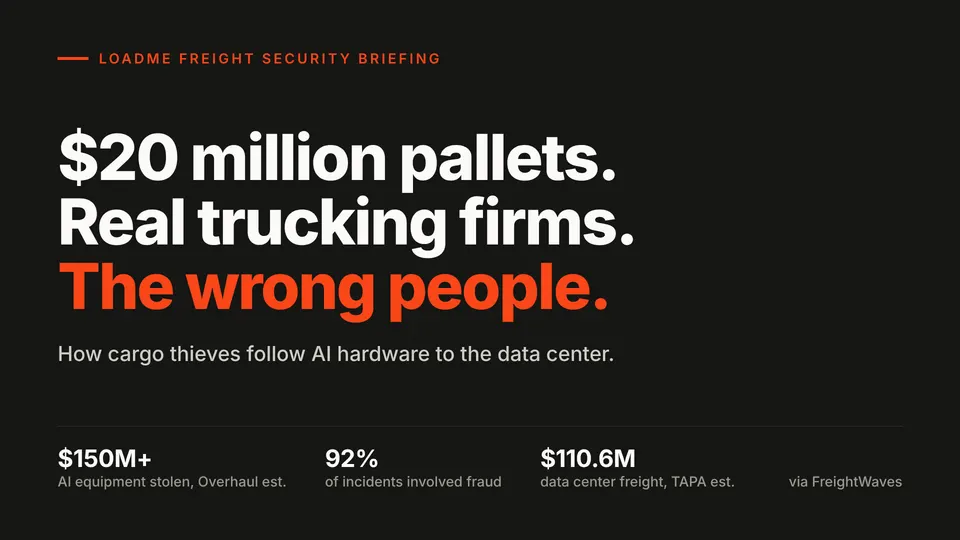
- Overhaul estimates that more than $150 million in AI equipment was stolen between June 2025 and June 2026. Fraud or deception was involved in 92% of the 111 U.S. incidents it analyzed.
- The method is fraud at the handoff. Criminal groups buy real trucking companies, win loads and collect freight with valid credentials. A federal jury convicted two men in September in a scheme that used purchased carriers.
- A credential check confirms a company. It says little about who runs that company today. Shippers lower their exposure by cutting handoffs, barring re-brokering, verifying the people behind a carrier and checking again at the dock.
The interstate highway system took 37 years and roughly $650 billion to build. Spending on artificial intelligence infrastructure now runs about double that figure every year across the globe, with a high percentage landing in the U.S. Both figures come from David Warrick, executive vice president of enterprise at the supply chain risk firm Overhaul. The second depends on the first, because the hardware that money buys spends part of its life on a truck.
"The bright and shiny data center sitting on the hill is not the problem," Warrick said in a FreightWaves article published Nov. 23. "It's the dirt road leading to the data center, which is where all of the challenges really are."
What travels that road has changed. Five years ago, by Warrick's account, a high-value load was a pallet of smartphones worth about a million dollars. "Now we're seeing $17 million pallets, $20 million pallets filled with Blackwell chips," he said, adding that "you've now got $100 million truckloads moving across the country."
A caution about the source belongs here. The article, written by Mary Goodson, ran under FreightWaves' Sponsored Insights label and ends with a link to Overhaul, which sells supply chain visibility and risk management services. Warrick names no victims and gives no dates. His account should be checked against other records, and the sections below do that with a federal jury verdict, theft data from Verisk CargoNet and reporting on a shipment that disappeared on its way from California to Texas. Those records support the outline of what he describes.
The New High-Value Target: Inside the AI Infrastructure Theft Wave
Overhaul put numbers on the problem in its AI Infrastructure Intel Report, released Oct. 21. According to FreightWaves' Nov. 13 account of the report, by Patrick Hatzis, the company estimates that thieves stole more than $150 million in AI equipment between June 2025 and June 2026. It analyzed 111 AI equipment theft incidents across the United States from 2023 through June 2026 and found fraud or deception in 92% of them. The number of incidents has risen 34% since 2024. A single flagship AI server rack, Overhaul estimates, costs roughly $3 million.
A second estimate comes from outside the company. Scott Cornell, chair of TAPA Americas, estimated on FreightWaves' Fraud Watch podcast that $110.6 million in data center freight had been stolen between June 3 and Aug. 14, 2026, the same article reported. FreightWaves noted that the two estimates cover different periods and categories of freight, so they should not be added together.
The most closely reported single case is also unresolved. On Aug. 29, a truck collected six pallets of NVIDIA computer hardware in Oakland, California, for delivery to Fort Worth, Texas, FreightWaves reported on Nov. 9. The load was worth a reported $11.4 million. The truck displayed a food transportation company's logo, according to The Mercury News, which FreightWaves cited. Oakland police are investigating a grand theft that was reported to them on Sept. 13. As of that report, police had not confirmed the value or identified the merchandise, investigators had not established whether anyone impersonated a transportation provider, and no arrests had been announced.
Broader theft data shows the same move toward fewer and richer targets. Verisk CargoNet recorded 2,072 incidents across the U.S. and Canada through September, down 25% from 2,755 a year earlier. Estimated losses rose 39% over the same period, to $718.9 million. Among thefts with a documented value, the average climbed about 72%, from $261,115 to $448,456. "Data center materials are among the valuable commodities attracting attention," said Keith Lewis, vice president of operations at Verisk CargoNet.
Chips are one part of the exposure. Warrick said demand has made nearly every component of a data center harder to find. "It's across all aspects of the build out of the infrastructure: generators, transformers, bus bars, high voltage switchgear, low voltage switchgear," he said. Of those parts, he said, "There's a big secondary market for them because of this year's scarcity." He did not cite a specific theft of that equipment, and neither do the other sources reviewed for this article. His claim is narrower. Tight supply, he said, makes even commodity-looking parts worth stealing.
For the companies building data centers, a stolen load is hard to replace at any price. "If I lose a specific component, I don't have an automatic way of being able to replace that because everything's already been bought and sold for the next number of years," Warrick said. Overhaul's report estimates that for every dollar of stolen hardware covered by an insurance claim, roughly $3 in additional losses go unclaimed. The company calls that a conservative estimate based on a RAND research paper.
Warrick also said that "there's a level of embarrassment around this," and that thefts "into the 10s of millions of dollars" have occurred in recent weeks.
How Organized Crime Exploits Load Boards and Handoffs
"Anywhere where there's a handoff in the supply chain tends to open up a level of weakness," Warrick said. The scheme he describes needs no break-in. It needs a trucking company.
"These are criminal gangs that have bought legitimate trucking companies and have been running them for some time as a legitimate business," he said, "and then started to gain traction on the load boards because people are not paying attention." The most common play, the article says, is also the simplest. Warrick described it as "fake paperwork from a driver, a legitimate trucking company who's been subcontracted twice and then picks up a load, and then just disappears."
Federal prosecutors have won a verdict on a version of that scheme. On Sept. 29, a jury in the Central District of California found two men guilty of conspiracy to commit theft from interstate or foreign shipments after a seven-day trial. One defendant and his co-conspirators, the Justice Department said, "purchased or fraudulently used real trucking companies to bid on authentic shipping contracts." In March 2024, that defendant met the owner of a Texas-based carrier to buy the company for approximately $22,000. Later that month a co-conspirator picked up a load of televisions in Fontana, California, for that carrier. It never reached its destination in Florida. Other loads were booked through freight brokers. The Justice Department put the estimated loss at a minimum of $2 million. Sentencing is set for Jan. 20, 2027.
The freight in that case was often high-value electronics such as televisions and laptops, along with appliances and other consumer goods. The release makes no mention of AI hardware. The method matches the one Warrick describes.
The trucking industry's largest trade group has described the same pattern. In a December 2025 commentary, American Trucking Associations President and CEO Chris Spear wrote that criminals are "increasingly turning to cyber tactics, impersonating legitimate carriers, hijacking load boards, and diverting freight." He wrote that this crime "has surged more than 1,500% since 2021." The commentary does not cite a source for that figure.
Recent data suggests the fraud increasingly runs through real identities. CCJ reported on Nov. 23 on Highway's third-quarter Freight Fraud Index Report, which found that compromised communications accounted for 40.2% of stolen loads in the quarter, up from 34.4% in the second quarter. Direct theft by rogue carriers accounted for 36.4%. Bad actors relied more on compromised carrier email accounts and on changes in a carrier's ownership, and in some cases offered sellers compensation to log in after a sale and submit false attestations. "A carrier's credentials may be real even as the people controlling its communications or operations change," said Demi Ramon, Highway's vice president of risk.
The disguises are physical too. "We've seen criminals who have quickly resprayed a truck. They've changed the DOT numbers. They've switched the license plates," Warrick said. "We've seen them use signal jammers." He sees "no typical MO in this one."
He describes the groups as "transnational organized criminal gangs" that operate with finance and HR departments and weigh their options like any business. "A pallet of smartphones for a million dollars, or a pallet with some Blackwell chips on it for $15 million, which are you going to take?" he said. The goods move easily "even across borders because they're not illegal goods." He pointed to Russia, Iran and China as destinations of concern. The article does not say that hardware from any particular theft has reached those countries.
Why Traditional Load Boards Struggle to Stop Strategic Theft
A credential check answers one question: is this a real trucking company in good standing? In the cases above, the answer was yes. The defendants in the federal case, prosecutors said, purchased established trucking companies. Warrick's gangs ran theirs "for some time as a legitimate business." The company was real. The people behind it had changed.
Timing is the second problem. "Onboarding tells you a carrier was legitimate on the day they signed up," Andrew Smith, senior vice president at Circle Logistics, said in the CCJ report. Hijacked MC numbers, compromised email accounts and double brokering, he said, can all occur after onboarding.
Even the federal record can lag. Highway warned, CCJ reported, that the Federal Motor Carrier Safety Administration's temporary suspension of biennial-update enforcement and inactivation of USDOT numbers during its transition to the Motus registration system could leave brokers checking outdated records.
Then there is the number of hands a load passes through. In the federal case, loads were booked through brokers. In a recovery the FreightWaves article recounts, a well-known carrier had subcontracted a load and the pickup turned out to be fraudulent. In Warrick's description of the common scheme, the company at the dock had been "subcontracted twice." In each account, the truck that arrived had been chosen by someone other than the owner of the freight.
Each of those steps is a handoff, and each handoff is a place where a real company with bad intent can enter the chain. Load boards exist to match freight with trucks quickly. That speed is their value, and it is the opening Warrick points to when he says the gangs gained traction "because people are not paying attention."
Tracking does not close the gap alone. A tracker reports where a truck is. It has no way of knowing whether the right company is driving it, and Warrick says thieves have used signal jammers. Barry Conlon, Overhaul's CEO and founder, said in the company's release that "as thieves become increasingly deceptive, visibility into a shipment alone isn't enough to stop it from being taken." Tracking still matters once identity is settled. In the recovery Warrick recounted, it was the first warning. "We were watching the load," he said. "We noticed an unscheduled stop." Overhaul worked with local law enforcement to intercept the load and recover it.
None of this means brokers or load boards are careless, and Highway's recommendations in the CCJ report are framed for brokers. The weakness sits in the structure. The more times a load changes hands before it reaches a truck, the more identities someone has to get right, and the less the freight's owner knows about who is coming.
Enforcement is unlikely to fix this soon. "This problem is not getting smaller," Warrick said. He cautioned that "we've got some work to do, even from a legislation perspective," and said the goal should be "a punishment that sticks." Spear's commentary backs the Combating Organized Retail Crime Act, which he wrote would give law enforcement "centralized data, better coordination across jurisdictions, and tougher penalties."
Closing the Chain-of-Custody Gap with Direct, Biometrically Verified Freight
Warrick's advice is plain. He encourages shippers to treat chain of custody as a control at the front line of security, something more than a paperwork exercise. He offers a test for how much attention a load deserves: "If you think about your shipments not as inventory but as cash, you would pay a lot more attention if you had a pallet loaded with dollar bills."
For a shipper, that advice comes down to two things: fewer handoffs, and knowing who stands on the other side of each one. LoadMe's design starts from both, and it is worth being exact about what the platform does and where its limits are.
LoadMe is a direct freight marketplace. Only shippers can post loads, so a carrier books from the company that owns the freight. LoadMe is not a motor carrier, freight broker or freight forwarder and does not arrange transportation, according to its Carrier User Agreement. It charges subscriptions and takes no commission on freight value, so no intermediary is reselling the load.
That takes the resale step out of the chain. The carrier agreement addresses the next one. A carrier may not "re-broker, double-broker, assign, or transfer the performance of any load booked through the Platform" to another carrier or anyone else. Each load must move under the carrier's own operating authority, with its own equipment and drivers. The platform says it monitors for any attempt to re-broker a load without authorization. On LoadMe, a load that is "subcontracted twice" has broken the agreement at the first subcontract.
The second part is knowing who is coming. Before a carrier can book, LoadMe checks its USDOT number against FMCSA for active authority and operating status, and staff approve, return or reject every carrier application. The insurance check runs again on every booking. Those are checks on a company, and a purchased carrier can pass them.
The next layer is about people. LoadMe verifies the identity of the individual acting for the carrier through its identity verification vendor, Persona, at onboarding and periodically afterward. The check may include a selfie and liveness test compared against a government-issued photo ID. Each driver completes identity verification "in their own name," and every driver on a load has completed it. A truck or trailer whose VIN or plate is already registered to another company is held for review.
At pickup, the driver app records the arrival, and the driver photographs the pickup paperwork and, at the other end, the signed proof of delivery. Under the carrier agreement, the driver also takes a selfie at each pickup, which LoadMe stores with the load. Arrivals at pickup and delivery are recorded by geofence. If the driver's phone stops reporting, LoadMe alerts the driver and then the carrier. LoadMe also lists AI operations monitoring and alerts among its features.
None of that makes theft impossible, and LoadMe does not claim it does. The shipper selects the carrier and bears the risk of that selection under LoadMe's Shipper User Agreement. A criminal group patient enough to buy a real carrier and seat real, verified people in its trucks could pass these checks, as it could pass anyone's. What changes is the cost of trying. A named person with a verified face stands behind the carrier and behind each driver. The load cannot be passed to a stranger without breaking the agreement. The shipper deals with the company whose truck will arrive.
Two limits deserve a plain statement. The carrier agreement's minimum cargo insurance is $100,000, a small fraction of one Blackwell pallet at Warrick's prices, so anyone shipping freight in that class needs its own coverage and its own security plan on any platform. And the dock still has to do its part. Smith's checklist for high-value lanes in the CCJ report includes this: "Verify carriers at the dock so staff can confirm the carrier is who it says it is, with no red flags, before loading."
LoadMe is signing up shippers and carriers through a waitlist ahead of launch. Shippers who want to choose their own carriers can see how the platform works and join from the shippers page. Carriers who want freight straight from the shipper can join from the carriers page.
Whatever tools a shipper uses, Warrick's closing advice costs nothing. "It's okay to take your time, and it's okay to check and double check," he said. His final point was about instinct: "If at any point in time something feels off, then just take a breath and actually double check again, because that's going to be way better than trying to explain $100 million loss."
Frequently asked questions
Why are cargo thieves targeting AI data center shipments?
Because the freight is worth far more per pallet than older targets and is hard to replace. Overhaul's David Warrick said in a FreightWaves article that pallets of Blackwell chips now run $17 million and $20 million, against about $1 million for a pallet of smartphones five years ago. Overhaul estimates more than $150 million in AI equipment was stolen between June 2025 and June 2026.
How do criminals use legitimate trucking companies for freight fraud?
They buy them. Warrick says criminal gangs have bought legitimate trucking companies, run them as real businesses for a time, then used them to gain traction on load boards. In September 2026, a federal jury in California convicted two men in a scheme that the Justice Department said "purchased or fraudulently used real trucking companies to bid on authentic shipping contracts."
How can shippers prevent double brokering on high-value loads?
Choose the carrier directly, bar re-brokering in writing and verify the people as well as the company. Circle Logistics' Andrew Smith advises verifying carriers at the dock and adopting a driver ID verification process. On LoadMe, only shippers post loads, the carrier agreement prohibits re-brokering, and carrier representatives and drivers complete identity verification.
How much AI hardware has been stolen in transit?
No official total exists. Overhaul estimates more than $150 million in AI equipment was stolen between June 2025 and June 2026. TAPA Americas chair Scott Cornell estimated $110.6 million in data center freight was stolen between June 3 and Aug. 14, 2026. FreightWaves notes the two figures cover different periods and categories of freight.
Sources
- FreightWaves (Sponsored Insights, for Overhaul): Cargo Thieves Are Chasing AI Hardware Down the Dirt Road to the Data Center, Mary Goodson, Nov. 23, 2026
- FreightWaves: AI cargo thefts top $150 million from June 2025 to June 2026, Patrick Hatzis, Nov. 13, 2026
- FreightWaves: $11.4 million in NVIDIA hardware vanishes during shipment from California to Texas, Phil Brink, Nov. 9, 2026
- Verisk: Fewer Cargo Thefts, Bigger Losses: Average Theft Value Jumps 72 Percent Year to Date, press release, Nov. 4, 2026
- U.S. Attorney's Office, Central District of California: Two Indian Nationals Found Guilty of Participating in Cargo Theft Scheme in Which Freight Was Stolen from Shippers, Sept. 29, 2026
- Commercial Carrier Journal: Cargo thieves pivot to compromised inboxes and truck stops ahead of holiday rush, Pamella De Leon and Jason Cannon, Nov. 23, 2026
- American Trucking Associations: Washington Must Put Cargo Thieves on Notice, Chris Spear, Dec. 17, 2025
- LoadMe: Carrier User Agreement and Shipper User Agreement
Note on sourcing: The Nov. 23 FreightWaves article quoted throughout is Sponsored Insights content produced for Overhaul, which sells supply chain visibility and risk management services. Figures attributed to Overhaul are the company's own estimates. Statements about LoadMe come from its website and user agreements. LoadMe publishes this blog.