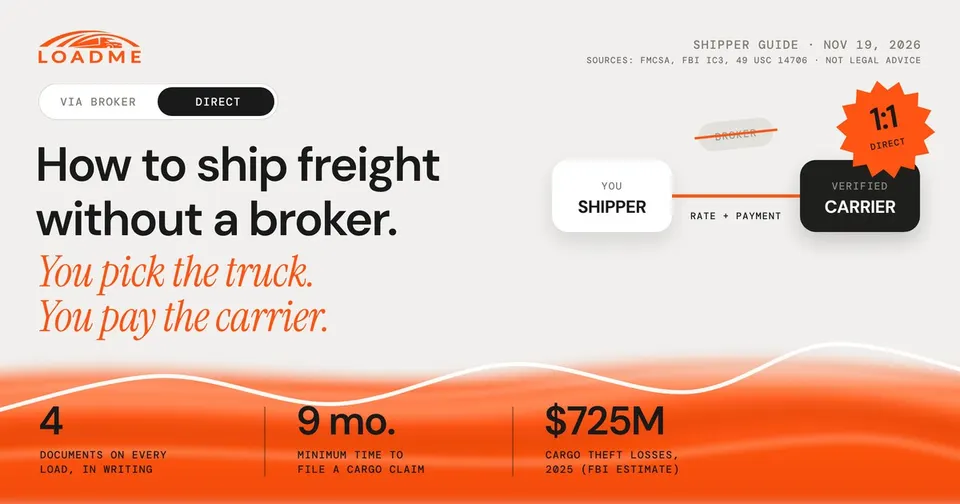
Shipping freight without a broker means you hire the motor carrier that moves your load yourself: you choose the truck, agree the rate with the company hauling it, and pay that company directly. The rate is the easy part. The work a broker did for you moves to your desk: finding carriers, checking that each one is authorized, insured and who it says it is, putting the terms in writing, following the load and handling a claim if something goes wrong. Set that work up once, then repeat it on every load.
What does it mean to ship freight without a broker?
It means the carrier at your dock is one you chose and contracted with. There are three common ways a load gets a truck:
- Through a broker. You tender the load to the broker, the broker picks a carrier and pays it, and the difference between the two rates stays with the broker. The carrier is the broker's choice, and you may not know its name until the truck arrives.
- Through your own carrier list. You tender directly to carriers you have approved, often from a routing guide that says which carrier gets each lane first.
- Through a direct freight marketplace. You post the load with your rate and terms, and verified carriers book it directly, with no one in between.
In the last two, the rate confirmation is between you and the carrier, and you pay the carrier.
Why do shippers book carriers directly?
For three reasons: knowing who has the freight, seeing what the carrier is paid, and keeping the relationship.
You know who has your freight. On a brokered load, the truck that arrives may belong to a company you never checked, or not even to the carrier the broker booked. FMCSA describes fraud and identity theft as occurring "when entities use another motor carrier's assigned USDOT number, when not authorized to do so, or when someone acts as a broker and is not registered with FMCSA." The FBI put estimated cargo theft losses in the United States and Canada in 2025 at nearly $725 million, and described criminals who pose as real carriers, accept loads and hand them to drivers who do not know the full story.
You see what the carrier is paid. Federal rules require a broker to record "the amount of compensation received by the broker" on each load, and each party has "the right to review the record" (49 CFR 371.3). FMCSA noted in 2024 that brokers often have carriers waive that right. When you book directly, the rate you pay is the rate the carrier receives.
The relationship is yours. A carrier that runs your lane every week learns your docks, your hours and your receivers, and you can call the person who dispatches the truck.
What does a broker do that you now do yourself?
Everything between "we have a load" and "the carrier is paid": finding carriers for each lane, checking them before the first load and after, agreeing terms in writing, preparing the bill of lading, following the load, paying on time and filing cargo claims.
Plan for the day a carrier cancels. For every lane that matters, have a second carrier who already knows the freight.
Where do you find carriers to book directly?
In four places, starting with the lanes you ship every week:
- Direct freight marketplaces, where you post the load and verified carriers book it.
- Carriers already at your docks. Ask your receiving team which inbound carriers arrive on time with clean paperwork.
- Regional carriers near your facilities that run the equipment you need.
- Other shippers and trade groups in your industry.
A carrier that can run a specific origin and destination on fixed days is worth more than a long list of carriers that might.
How do you check a carrier before you tender a load?
Before the first load, look the carrier up in FMCSA's public SAFER Company Snapshot and its registration record (Licensing and Insurance, now in Motus), and check:
- Authority: active, with no revocation pending, and how long since it was granted. FMCSA now issues new USDOT and MC numbers at random, so the number no longer tells you a carrier's age.
- Insurance on file with FMCSA, not only the certificate the carrier emails you. The federal minimum for general freight in vehicles of 10,001 pounds or more is $750,000 of liability coverage (49 CFR 387.9). Cargo insurance is not federally required for property carriers other than household goods movers, so if you need it, put the amount in your agreement.
- Safety: the rating if there is one, inspections, out-of-service rates and crashes for the past 24 months.
- Contact details that match the SAFER record.
Then check again at the dock. FMCSA advises confirming that "the name and numbers on the truck that shows up to load are the same as the one with which you contracted."
Keep a dated record of what you checked. In May 2026, in Montgomery v. Caribe Transport II, the Supreme Court held that federal law does not block state negligent-hiring claims against a broker that selects an unsafe carrier. The case concerned a broker, not a shipper, but anyone who picks carriers should be able to show how each one was chosen. Our carrier vetting guide covers each check and how often to repeat it.
What should you have in writing?
Four documents: an agreement with each regular carrier, then a rate confirmation, a bill of lading and a proof of delivery for every load.
A transportation agreement with each carrier you use regularly: insurance minimums, cargo liability, claims, payment terms, and a promise that the carrier will not hand your load to another company. Federal law lets a carrier and a shipper "expressly waive" rights and remedies in writing for the freight a contract covers; only registration, insurance and safety fitness cannot be waived (49 USC 14101(b)). Read every waiver before you sign, and have an attorney review the liability and indemnity clauses.
A rate confirmation for each load: origin and destination, dates and appointment times, equipment, commodity and weight, the rate, accessorials such as detention, layover and extra stops, free time, and payment terms.
A bill of lading. Federal rules require the carrier to issue a receipt or bill of lading showing the consignor and consignee, origin and destination, number of packages, description of the freight, and weight, volume or measurement where it affects the rate (49 CFR 373.101). Many shippers prepare their own and have the driver sign it at pickup.
A proof of delivery, signed by the receiver, with any shortage or damage written on it.
Who pays if freight is lost or damaged?
Usually the carrier. On interstate shipments, the Carmack Amendment makes the carrier liable for "the actual loss or injury to the property" it carries, and failing to issue a bill of lading "does not affect the liability of a carrier" (49 USC 14706(a)(1)). These rules apply unless your transportation agreement expressly waived them under 49 USC 14101(b), so check the agreement before you sign.
A carrier can limit that liability to a value set by your written or electronic declaration or by a written agreement, if the value is reasonable (49 USC 14706(c)(1)(A)). Look for a cap per pound or per load in the rate confirmation and the carrier's rules, and make sure its cargo coverage fits the value of what you ship.
The deadlines protect you. A carrier may not give you less than 9 months to file a claim. If it disallows any part of the claim in writing, you have at least 2 years from that notice to sue (49 USC 14706(e)(1)). Your bill of lading or agreement sets when the 9 months start, so check it and file early.
How to file:
- Put the claim in writing. It must identify the shipment, say the carrier is liable, and ask for a specified or determinable amount (49 CFR 370.3(b)).
- Do not stop at a note on the delivery receipt. A notation of damage, standing alone, does not count as a claim (49 CFR 370.3(c)). It is still good evidence, so write it down and take photos.
- Expect deadlines on the carrier's side too. The carrier must acknowledge the claim in writing within 30 days, unless it has already paid or declined it (49 CFR 370.5). It must pay, decline or make a firm settlement offer within 120 days. If it cannot, it must tell you in writing why, at that point and every 60 days after while the claim stays open (49 CFR 370.9).
How do you set rates and payment terms carriers will accept?
There is no public price list for truckload freight. Start from what you paid on the same lane, ask two or three carriers, and adjust for season and equipment.
- Fuel. On lanes you contract for months at a time, tie a fuel surcharge to the U.S. Energy Information Administration's weekly average on-highway diesel price, so both sides use the same public number.
- Accessorials. State free time and the detention rate on every load. Disputes start when they are left to the invoice. Our detention pay guide explains how arrival and departure times are proved.
- Payment terms. Small carriers pay for fuel and trucks long before most shippers pay invoices. Faster payment can win you better carriers on hard lanes.
- Factored invoices. If you receive a notice of assignment from a carrier or its factoring company, pay the factoring company it names. Under the Uniform Commercial Code, once you have that notice you "may not discharge the obligation by paying the assignor" (UCC 9-406(a)), so paying the carrier can mean paying twice. Check your state's version with an attorney if a notice is disputed, and confirm any change of payment details by calling the number in SAFER. See our freight factoring guide.
How do you start?
Start small and expand once the process works.
- Pick one or two lanes you ship every week.
- Write your carrier requirements: equipment, insurance limits including cargo, safety thresholds and payment terms.
- Find at least two carriers for each lane, check them, and sign the agreement.
- Agree on tracking before pickup: location updates or check calls, and a call ahead of any delay.
- Run a month of loads and track on-time pickups and deliveries, paperwork and problems.
- Add lanes when the first ones run without surprises.
Expect the first month to take more of your team's time. In return, you know exactly who moves your freight.
How does LoadMe work for shippers?
We run a direct freight marketplace, so weigh this section knowing we have a stake in your decision. On LoadMe, you post a load with your rate, lane, equipment, commodity, weight, accessorials and payment terms, and verified carriers book it at your price. The rate confirmation is between you and the carrier, and the bill of lading is issued in your name.
Before a carrier can book, LoadMe checks its USDOT number against FMCSA for active authority and operating status, and reads its certificate of insurance for the expiry date, coverage minimums and named insured. LoadMe staff approve, return or reject every carrier application, and the insurance check runs again on every booking. Arrivals at pickup and delivery are recorded by geofence, the driver photographs the pickup paperwork and the signed proof of delivery, and you approve or reject the proof of delivery from your dashboard.
You pay the carrier directly on the terms you set, from Quick Pay to Net 60. LoadMe takes no percentage of the freight charge. Plans start at $79 a month for the self-guided Simple plan; Basic is $499 a month for 50 to 150 loads a month; Pro and Enterprise are priced per account. See LoadMe for shippers and how LoadMe works.
Sources
- FMCSA, Broker and Carrier Fraud and Identity Theft, last updated 7 Apr 2025: https://www.fmcsa.dot.gov/mission/help/broker-and-carrier-fraud-and-identity-theft
- FBI Internet Crime Complaint Center, Cyber-Enabled Strategic Cargo Theft Surging, alert I-043026-PSA, 30 Apr 2026: https://www.ic3.gov/PSA/2026/PSA260430
- eCFR, 49 CFR 371.3, records to be kept by brokers: https://www.ecfr.gov/current/title-49/section-371.3
- Federal Register, Transparency in Property Broker Transactions, proposed rule, 89 FR 91648, 20 Nov 2024: https://www.federalregister.gov/documents/2024/11/20/2024-27115/transparency-in-property-broker-transactions
- FMCSA SAFER Company Snapshot: https://safer.fmcsa.dot.gov
- FMCSA, Changes to FMCSA Registrations in Motus (fact sheet, May 2026, random USDOT and MC numbers): https://www.fmcsa.dot.gov/sites/fmcsa.dot.gov/files/2026-05/Motus%20Changes%20to%20FMCSA%20Registrations.pdf
- eCFR, 49 CFR 387.9, minimum insurance: https://www.ecfr.gov/current/title-49/section-387.9
- Supreme Court of the United States, Montgomery v. Caribe Transport II, LLC, 608 U.S. 219, decided 14 May 2026: https://www.supremecourt.gov/opinions/25pdf/608us1r32_g3bi.pdf
- 49 U.S.C. 14101, contracts with shippers (United States Code, 2024 edition, govinfo): https://www.govinfo.gov/content/pkg/USCODE-2024-title49/html/USCODE-2024-title49-subtitleIV-partB-chap141-subchapI-sec14101.htm
- eCFR, 49 CFR 373.101, motor carrier bills of lading: https://www.ecfr.gov/current/title-49/section-373.101
- 49 U.S.C. 14706, liability of carriers under receipts and bills of lading (United States Code, 2024 edition, govinfo): https://www.govinfo.gov/content/pkg/USCODE-2024-title49/html/USCODE-2024-title49-subtitleIV-partB-chap147-sec14706.htm
- eCFR, 49 CFR 370.3, 370.5 and 370.9, filing, acknowledgment and disposition of claims: https://www.ecfr.gov/current/title-49/part-370
- U.S. Energy Information Administration, Gasoline and Diesel Fuel Update (weekly on-highway diesel prices): https://www.eia.gov/petroleum/gasdiesel/
- Uniform Commercial Code 9-406, discharge of account debtor and notification of assignment (Cornell Law School, Legal Information Institute): https://www.law.cornell.edu/ucc/9/9-406
- LoadMe for shippers (verification, posting, tracking, payment terms and plan prices): https://loadmeboard.com/shippers