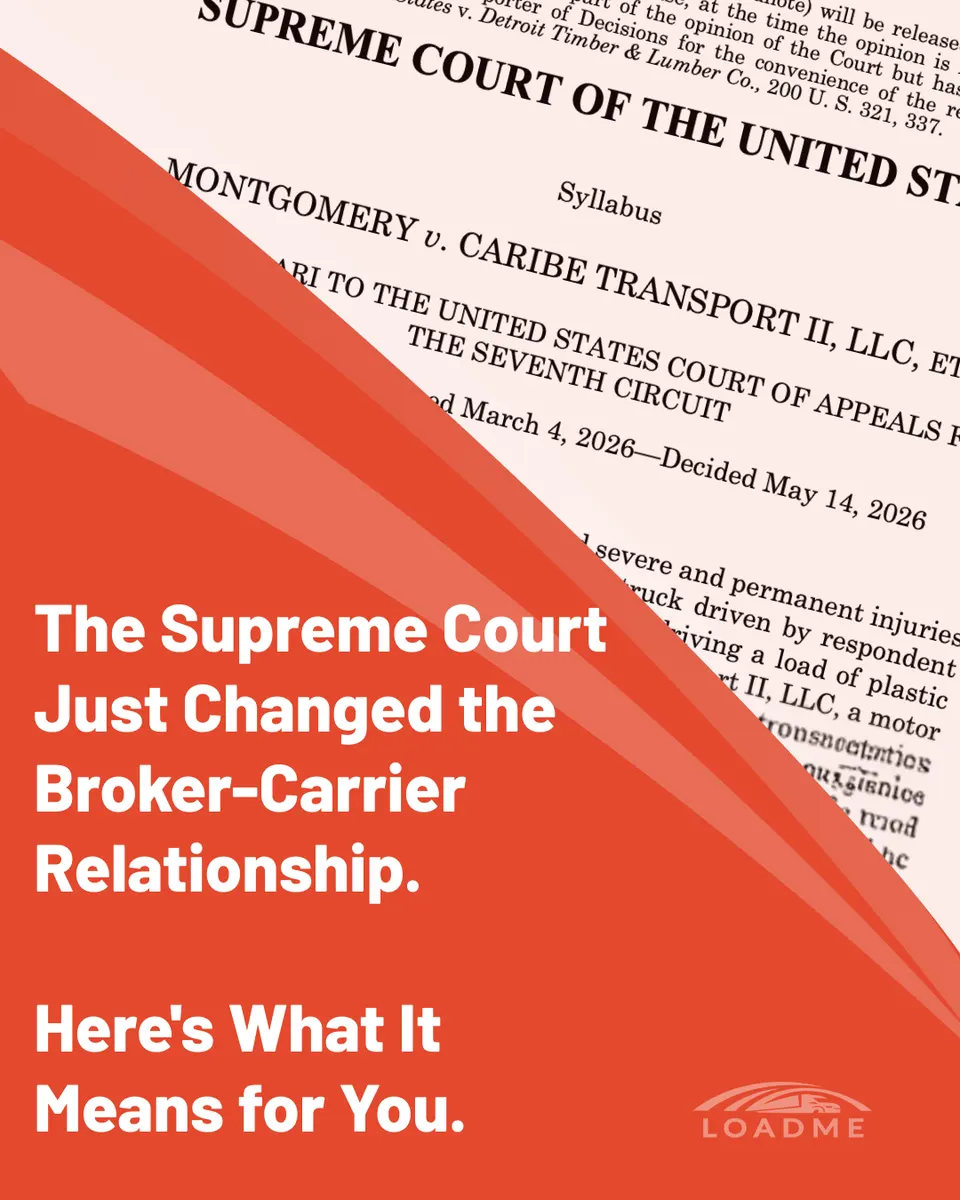
On May 14, 2026, the Supreme Court delivered a ruling that changes how freight moves in this country. Not eventually. Now.
In a 9-0 decision authored by Justice Amy Coney Barrett, the Court ruled in Montgomery v. Caribe Transport II that freight brokers can be sued under state law for negligently hiring unsafe carriers. The federal preemption defense that brokers have leaned on for decades, the argument that federal law shields them from state negligence claims, is done.
If you're a carrier, this directly affects how brokers will select you for loads. If you're a shipper, this changes the risk profile of every broker relationship you have. Here's what happened and what it means.
The Case
On December 7, 2017, Shawn Montgomery was stopped on the shoulder of Interstate 70 in Illinois with a mechanical issue. A tractor-trailer driven by Yosniel Varela-Mojena rear-ended Montgomery's stopped vehicle. Montgomery lost his leg and suffered permanent disfigurement.
Varela-Mojena was driving for Caribe Transport II, an Indiana-based motor carrier. The shipment had been arranged by C.H. Robinson, the largest freight broker in the United States.
Here's the critical detail: when C.H. Robinson hired Caribe Transport, the carrier had a conditional safety rating from the FMCSA with documented deficiencies in driver qualification, hours of service, maintenance, and crash rates. Montgomery sued C.H. Robinson, arguing the broker was negligent in selecting a carrier it knew, or should have known, was unsafe.
C.H. Robinson's defense was straightforward: federal law preempts this claim. The Federal Aviation Administration Authorization Act of 1994 (FAAAA) bars state laws "related to a price, route, or service" of brokers. A negligence lawsuit, C.H. Robinson argued, falls squarely under that protection.
The district court and the 7th Circuit Court of Appeals agreed with C.H. Robinson. Montgomery appealed to the Supreme Court.
The Ruling
The Supreme Court reversed, unanimously.
Justice Barrett's opinion focused on a specific exception in the FAAAA. While the law does preempt state regulation of broker services, it carves out an exception for "the safety regulatory authority of a State with respect to motor vehicles." Barrett held that a negligent-hiring claim, one that asks whether a broker used ordinary care in selecting a carrier, directly concerns the motor vehicles that will be on the road. It falls within the safety exception.
The legal standard going forward is ordinary care. Courts will ask: did the broker act reasonably in selecting the carrier? Did they review available safety data? Did they have a documented vetting process? Did they identify and address red flags?
Justice Kavanaugh filed a concurrence, joined by Justice Alito, acknowledging the case was closer than the majority opinion might suggest. He noted the ruling could increase broker insurance costs that would eventually cascade through the economy. But he also wrote that brokers who act reasonably and select reputable carriers should be able to defend against these suits. And he was direct about the stakes: truck safety, he wrote, is a matter of life and death.
What This Means for Carriers
This ruling makes your safety record one of the most valuable things you own.
Before this decision, a broker could hire the cheapest carrier available without meaningful legal risk as long as that carrier had federal registration, the broker was largely shielded from liability. That shield is gone. Brokers are now exposed to state-law negligence claims if they select a carrier with documented safety issues and that carrier causes harm.
The practical result: brokers are going to tighten their carrier selection. They will increasingly steer freight toward operators they can defensibly select carriers with clean safety records, documented compliance history, and verifiable credentials. Industry analysts expect brokers to invest significantly more in carrier vetting processes.
If you're an owner-operator or small fleet running clean, this is a competitive advantage. Your investment in maintenance, compliance, and safe operations now has direct, measurable value in how brokers evaluate you.
If your safety record has gaps like unresolved violations, outdated documentation, conditional ratings then those gaps just became more expensive. Brokers facing new liability exposure are going to be less willing to take chances on carriers they can't defend hiring in court.
What This Means for Shippers
This ruling adds a new layer of risk to every broker relationship.
If your broker gets sued for negligently hiring an unsafe carrier, your supply chain takes the hit translating into delays, capacity disruptions, potential cost pass-throughs as broker insurance premiums rise. Justice Kavanaugh flagged this directly: higher broker insurance costs will cascade through the freight economy.
Industry groups expect brokers to conduct more extensive investigations before assigning loads, which could slow freight operations. Some brokers may narrow their carrier pools to reduce litigation exposure, which could tighten capacity in certain lanes.
For shippers, this is a moment to evaluate how much risk sits in the broker layer of your supply chain. The more intermediaries between you and the carrier actually moving your freight, the more exposure you carry when something goes wrong.
What This Does NOT Mean
A few things worth clarifying, because the industry reaction has been heated:
This does not mean brokers are automatically liable for every accident. The ruling allows negligent-hiring claims to proceed in state court. It does not create strict liability. Brokers who perform reasonable due diligence in carrier selection and document their vetting process should be well-positioned to defend against these claims. Justice Kavanaugh's concurrence emphasized this point specifically.
This does not change federal registration requirements. Your USDOT number, operating authority, and FMCSA registration are unaffected. The ruling is about state-law tort claims, not federal regulatory structure.
This does not eliminate brokers from the freight ecosystem. Brokers will adapt. The ones who already invested in strong carrier vetting processes are ahead of the curve. The ones who relied on federal preemption as a substitute for due diligence are the ones feeling this.
The Bigger Picture
This ruling didn't happen in isolation. It landed the same week the FMCSA launched Motus, its new registration system built around mandatory identity and business verification. Both moves point in the same direction: the freight industry is tightening around accountability, verification, and transparency.
For carriers, the takeaway is clear. The operators who invest in safety, maintain clean records, and make themselves easy to verify are the ones who get the freight, whether through brokers who now have to justify their selections, or through direct relationships with shippers who want to reduce their broker-layer risk.
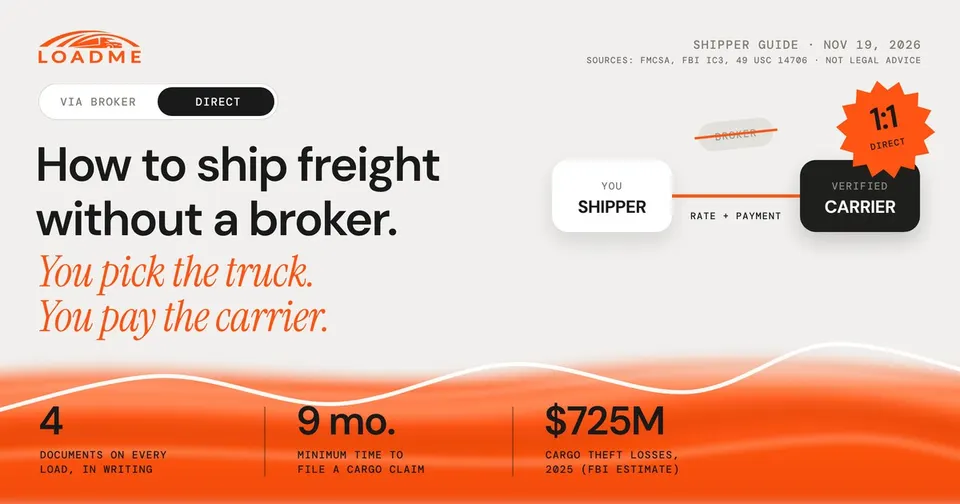
For shippers, the calculus is shifting. Every intermediary in your supply chain is now a potential liability node. Direct relationships with verified carriers don't carry that risk.
That's the model LoadMe is building. A direct freight network where verified carriers connect straight to shippers — no broker, no intermediary liability, no middleman markup. Early access is open at loadmeboard.com.
LoadMe is a direct freight network connecting shippers and carriers without intermediaries. Currently in pre-launch. loadmeboard.com