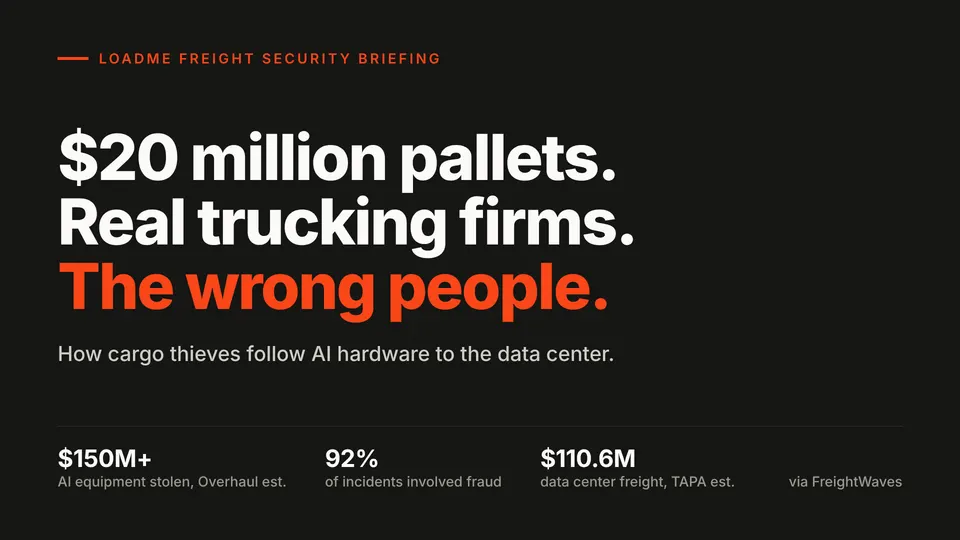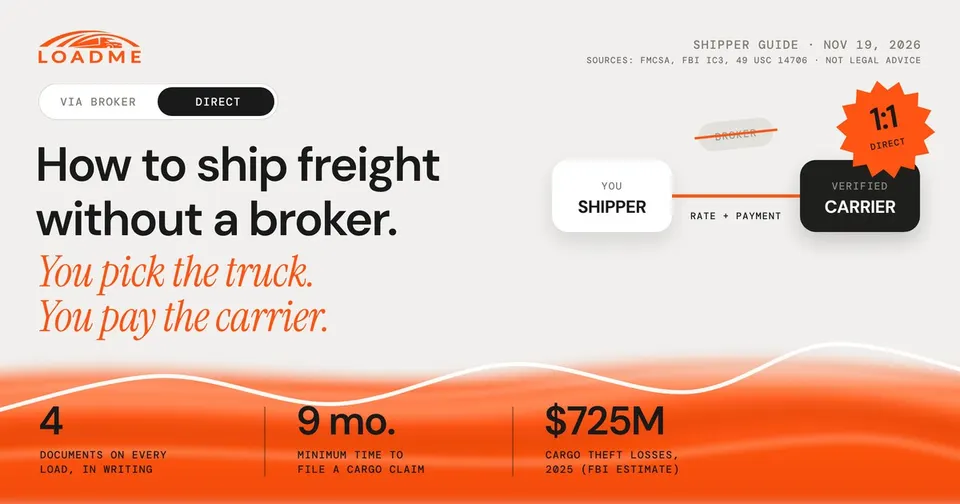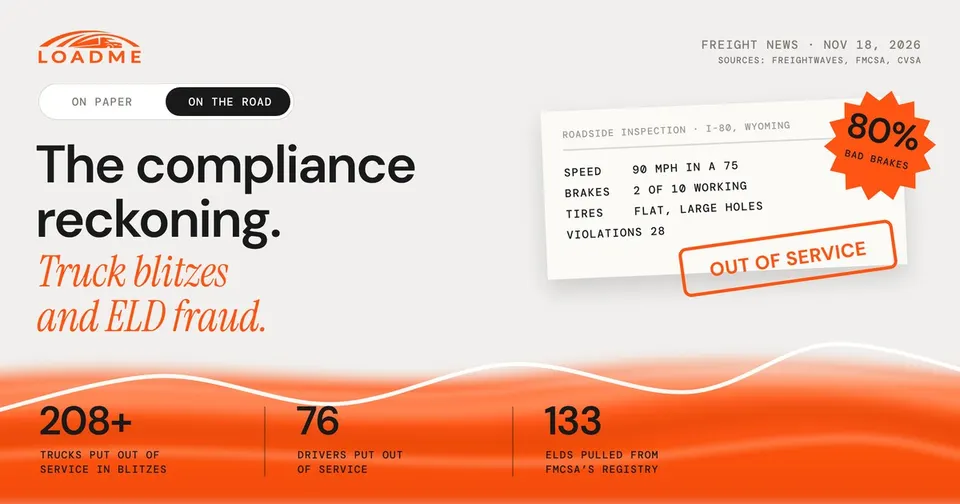
💡 TLDR: Capacity is tight and staying tight. FreightWaves SONAR's truckload rejection index sits near 13%, more than double the sub-6% readings of last peak season. Small-fleet tractor counts are down about 9% from their 2023 high, and enforcement is removing roughly 2,700 drivers a month.Diesel has reset every carrier's break-even. At $6.127 a gallon, nearly 60% above last year, fuel runs about 94 cents a mile at 6.5 mpg, or roughly $35,000 more per truck per year. Carriers that cannot state their cost per loaded mile are handing back the pricing power the market just gave them.
Duplicate postings are inflating spot costs. One lane was posted 41 times by 27 brokers, and the same truck quoted through four brokers can add $300 to a load by mid-afternoon. Shippers still running long rate locks and penalty-heavy bids are pushing more of their freight into that noise.
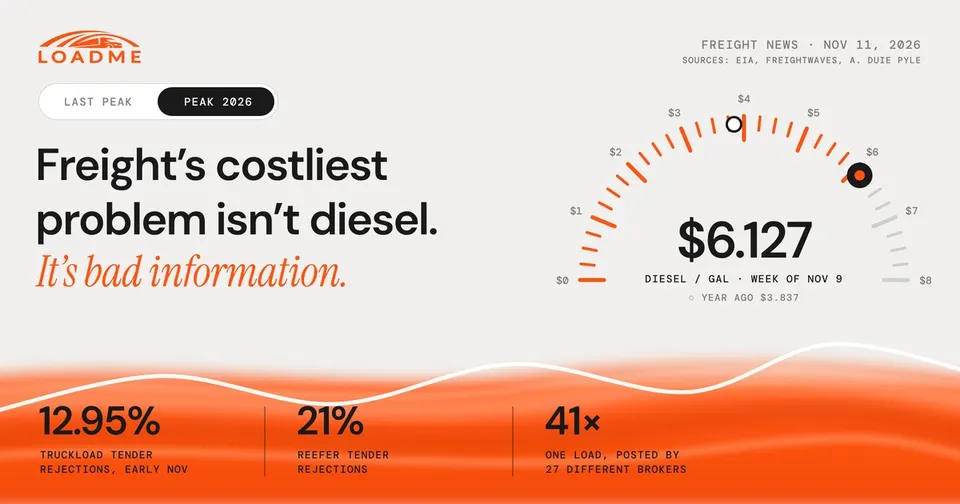
Earlier this year, a single truckload needed to get from Baltimore to a remote corner of New England. By the time carriers went looking for it, the load had appeared on load boards 41 times, posted by 27 different brokers, according to Craig Lough, director of strategic planning at A. Duie Pyle, who described the episode to FreightWaves. One shipment, one truck needed, 41 invitations to bid.
Lough called it an extreme case. It is also the clearest available picture of the freight market heading into peak season 2026. Capacity is scarce, diesel costs $6.13 a gallon, and much of what passes for price discovery is the same load and the same truck echoing through multiple intermediaries. The scarcest input this winter is accurate information, and a large part of the market is paying for the lack of it.
A Tight Market With Fewer Small Trucks in It
The headline numbers favor anyone who owns a truck. FreightWaves SONAR's truckload tender rejection index stood near 13.9% in mid-October and 12.95% in early November, against a trailing 12-month average of 8.18% and readings under 6% during last year's peak. Carriers are turning down roughly one in eight contracted tenders.
Demand is holding up. November tender volumes are running about 12% above the same month last year, FreightWaves analysts reported this week, and refrigerated rejections have climbed to 21% from 12.6%. Dry van spot rates have largely flattened, which is why the market feels calmer than the data suggests.
Supply explains the rest. SONAR counts 362,033 tractors in fleets of one to six power units, down nearly 36,000, or about 9%, from the early-2023 peak. English-language proficiency enforcement is removing roughly 2,700 drivers a month from service. Tractors entering new for-hire fleets totaled 19,520 in August, less than half the mid-2022 pace of about 47,000.
The $6 Gallon Rewrites the Math on Every Mile
Pricing power means little if the cost side absorbs it. The national average for on-highway diesel was $6.127 a gallon in the week of Nov. 9, according to the Energy Information Administration's weekly survey. That is down 16.5 cents from the prior week and still nearly 60% above the $3.837 of a year earlier. California averaged $7.897.
Translate that into the unit that matters. At 6.5 miles per gallon, fuel now costs about 94 cents a mile, up from 59 cents a year ago, by our calculation. For a truck running 100,000 miles a year, that is roughly $35,000 in added fuel expense before a single rate negotiation.
Fuel surcharges recover part of that on contracted, loaded miles. They recover nothing on deadhead, and spot freight is usually quoted all-in, which leaves the carrier to price fuel correctly on its own. A 100-mile reposition now burns about $94 in diesel before the truck earns a dollar.
That is the backdrop for a FreightWaves sponsored feature this week in which Josh Lovan, industry business advisor at J. J. Keller & Associates, argued that fleets should stop treating fuel, safety, maintenance and compliance as separate conversations. "None of us can control the price at the pump," Lovan said. His checklist covers what fleets can control: know true cost per mile, track miles per gallon by vehicle, audit fuel card transactions for theft, and use the telematics already installed to find idling, poor routing and deadhead.
Other costs are moving the same direction. Liability and cargo insurance premiums rose 3.9% in 2025 to about 10.6 cents a mile, according to American Transportation Research Institute figures cited by FreightWaves, and truckload operating margins were barely positive last year. A carrier that cannot state its break-even rate per loaded mile is negotiating blind in the tightest market in at least three years.
Shippers Are Still Running the Loose-Market Playbook
On the other side of the table, many shippers have not adjusted. Lough told FreightWaves that some are entering peak with the bid strategy that served them from 2022 through 2025: long rate locks, steep penalties and little flexibility.
The terms are striking. Some bids hand over lane data five months before go-live and then ask providers to hold rates for a year after that. Lough calls it a 17- to 18-month risk window in what he described as probably the first or second most volatile market of this century. One bid opened with a 98% tender acceptance expectation and a $1,000 fine for late delivery.
The predictable result is what Lough calls paper rates: prices that win the bid and then fail to produce a truck. Routing guides are already losing freight to the spot market. "What works in a falling market is a giant red flag in a tightening point," he said.
Phantom Freight and the Late-Day Premium
When the routing guide fails, the load goes out to everyone, and the noise starts. Lough warned against sending a shipment to a list of 50 carriers and brokers, and said even three or four brokers on one load can mislead a shipper. Carriers call each broker in turn, each call returns a slightly higher number, and the shipper reads rising quotes as a rising market.
His example: a truck offered at $1,100 in the morning wants $1,400 by 3 p.m. "In reality, it's just the same truck making offers to four brokers," Lough said. In that scenario the shipper pays a 27% premium for a market move that never happened.
Carriers pay as well. Forty-one postings for one load means dispatchers spend calls and hours chasing freight that only one of them can haul. With fuel near a dollar a mile, phantom freight has become a real operating cost.
Brokers are squeezed from both directions. In its unanimous May 14 ruling in Montgomery v. Caribe Transport II, the Supreme Court held that federal law does not shield brokers from state negligent-hiring claims over carrier selection, which raises the stakes on vetting. Lough reports that small carriers that fail Pyle's standards have been calling "left and right," a sign, in his reading, that other companies are tightening their standards and pushing that capacity back onto the open market. Carriers with strong reputations, he added, are no longer hauling at the rates they accepted two or three years ago.
Lough has proposed transparent cost-plus pricing, in which the broker shows the shipper what the carrier is paid and adds a disclosed markup. No shipper has accepted it yet.
What to Do Before Thanksgiving
FreightWaves analysts say the two weeks around Thanksgiving will be the clearest test of whether this market can set up a tighter 2027 contract season. Lough's deadline is the same. He wants shippers talking with carriers and brokers before the holiday, because Northeast freight gets harder from then through January.
For carriers, the work is arithmetic. Recalculate cost per mile at current diesel, set a floor rate per loaded mile, and decline freight below it. In a market rejecting one in eight tenders, that discipline is worth more than one more load.
For shippers, the fix is fewer and better conversations. Shorten rate locks, drop penalty-first bid language, share lane details such as shipping hours and delivery windows, and give each load to one accountable party instead of a distribution list.
For brokers, the margin now sits in qualified capacity and service that holds up under legal scrutiny. Reposting someone else's load adds a 42nd listing and no value.
The Infrastructure Question
Read together, the two FreightWaves pieces describe the same defect from opposite ends. Carriers lose money when they cannot see their own costs clearly. Shippers lose money when they cannot see the market clearly. Both problems get worse with every layer added between the freight and the truck.
That is the problem LoadMe was built around. On Loadmeboard.com, a shipper posts its own load once and FMCSA-verified carriers respond directly, so one shipment appears as one shipment. Carriers pay a flat monthly subscription instead of a per-load commission. A built-in cost calculator converts fixed, variable and percentage costs into a target rate per loaded mile, the figure every fleet is now being told to know, while identity verification, ELD integration and audit trails supply the documentation that tighter carrier standards demand.
LoadMe is opening corridor by corridor, beginning in the Midwest across Cleveland, Chicago and Columbus. The premise can be tested on a single lane: when capacity is scarce and diesel costs $6, the cheapest mile is the one nobody wastes, and the most reliable quote is the one a shipper only has to ask for once.
Sources
- Shippers running 2022-era bid playbooks face a tighter peak, FreightWaves, Thomas Wasson, Nov. 11, 2026
- High Diesel Prices Put Fleet Efficiency Under the Microscope, FreightWaves Sponsored Insights (J. J. Keller & Associates), Mary Goodson, Nov. 11, 2026
- Where Trucking Capacity Sits Right Now, And What The Fleet-Size Split Might Be Signaling, FreightWaves, Adam Wingfield, Nov. 10, 2026
- Trucking Market: Why Is It Flat Despite 12.8% Rejection?, FreightWaves, Nov. 10, 2026
- Is Trucking Capacity Coming Back? Why New Capacity Isn't Entering the 2026 Freight Market, FreightWaves, Julie Van de Kamp, Oct. 7, 2026
- Gasoline and Diesel Fuel Update, U.S. Energy Information Administration, released Nov. 10, 2026
- Supreme Court Decides Montgomery v. Caribe Transport II, LLC, Faegre Drinker, May 14, 2026
Note on sourcing: per-mile and per-truck fuel figures are LoadMe calculations from EIA prices, assuming 6.5 miles per gallon and 100,000 miles a year.