Small carriers are running out of money while the largest names in logistics field ransom demands. The two stories meet in the records of the same trucking companies.
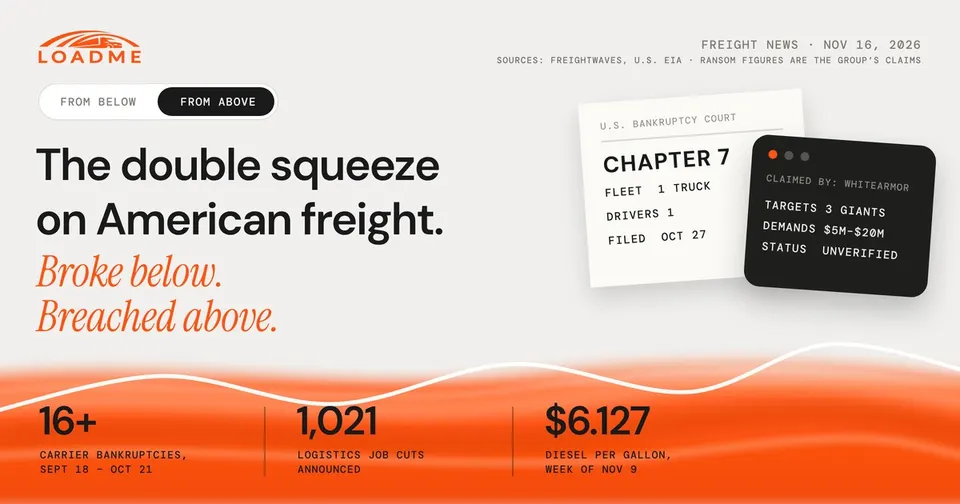
Two pressures are converging on American freight in late 2026. Small carriers are filing for bankruptcy under debt and rising operating costs, and logistics employers have announced more than 1,000 job cuts. At the same time a new ransomware group, Whitearmor, claims to have breached J.B. Hunt, Ryder and Echo Global Logistics and is demanding millions in ransom.
JYM Trucking Inc. entered Chapter 7 in Florida on Oct. 27 with one truck and one driver. Two weeks later a livestock carrier in El Paso, X-Total Cattle Transportation LLC, filed for Chapter 11. It had previously run four trucks and employed five drivers, and its federal registration had gone inactive in October. It listed less than $50,000 in assets against at least $500,000 in liabilities.
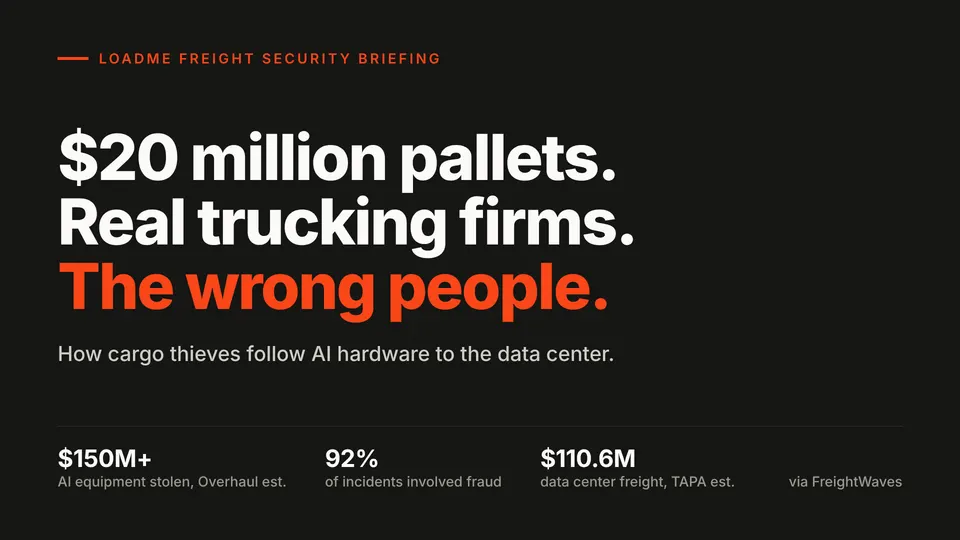
At the other end of the industry, J.B. Hunt was answering for a different kind of loss. A ransomware group that surfaced in October, Whitearmor, claims to hold 140,838 of the company's employee records and 1.7 million carrier contacts. Its posted demand was $5 million.
FreightWaves reported all of this within a few weeks. One story is about money and the other is about data, and they look unrelated. They are connected by who absorbs the damage: the small carriers that make up most of American trucking.
Why are trucking companies going bankrupt in late 2026?
FreightWaves's reviews of the filings give few reasons. What the filings show is debt that outgrew the business.
A FreightWaves review of federal bankruptcy records found at least 16 carriers that filed between Sept. 18 and Oct. 21. A second review counted 15 transportation, distribution and freight-related businesses with filings dated Sept. 14 through Nov. 10, 13 of them since Oct. 19. The two windows overlap, so the counts should not be added together.
Most of the carriers in the first tally list fewer than 10 trucks. Midwest Expedited Co. of Chicago listed about $2.31 million in liabilities against $108,351 in assets. Its LinkedIn page claims 95 trucks, and its bankruptcy schedules identify seven. Site2Site Transport of El Paso reported gross revenue of about $2.1 million in 2024 and $1.6 million in 2025, then none at all in 2026 before it filed for liquidation. The filing for Eskil Trucking of Lakeview, Oregon, identified nearly $855,000 owed to another trucking company in the same part of the state, its largest creditor claim.
FreightWaves was careful about what this proves. The filings, it wrote, "alone do not establish an industrywide increase in bankruptcies." Its later report described trucking firms, warehouse operators and freight service providers as facing rising operating expenses.
One of those expenses is easy to measure. On-highway diesel averaged $6.127 a gallon in the week of Nov. 9, according to the Energy Information Administration, nearly 60% above the same week a year earlier. Revenue has not kept up everywhere. FreightWaves analysts said last week that dry van spot rates have largely flattened, even with carriers rejecting about one in eight contracted loads.
Who is losing jobs in logistics?
Mostly warehouse and contract logistics workers. FreightWaves compiled layoff announcements and WARN notices from at least 10 companies between late October and Nov. 11. Together they cover 1,021 jobs.
National Distribution Centers plans to close its Perris, California, facility on Jan. 4, eliminating 167 jobs, and to cut 126 more in Groveport, Ohio. DSV Contract Logistics plans to eliminate 175 jobs in Edwardsville, Illinois, beginning Dec. 5, after losing a customer contract. CEVA is cutting 120 positions in Lockbourne, Ohio, by June 2027. Amazon has announced plans to close a fulfillment center in La Puente, California, affecting 94 employees.
These are announced reductions, and some will not take effect for months. They still show where the pressure is moving. When a customer contract ends, a building closes, and the freight that moved through it stops moving.
What is the Whitearmor ransomware group, and what does it claim?
Whitearmor is new. Ben Wilkens, director of cybersecurity at the National Motor Freight Traffic Association, told FreightWaves the group "came on the scene very recently, October of this year," and carries out "very targeted attacks of vulnerable webservers."
Three logistics companies have been targeted since late October, FreightWaves reported on Nov. 11. What is known about each comes from different places, and the differences matter.
J.B. Hunt has said it is investigating a cybersecurity incident. A spokesman told the Arkansas Democrat-Gazette it involved "unauthorized access to certain information," and that the company had notified law enforcement and revoked the access. "Our systems remain operational, and there has been no disruption to our ability to serve customers," he said. The tracking site ransomware.live dates the attack to Oct. 23 and carries the group's claims and its $5 million demand.
Ryder declined comment on the cyberattack and the lawsuits that followed, FreightWaves reported. Ransomware.live lists a $20 million demand in bitcoin.
Echo Global Logistics had not responded to FreightWaves by publication. A lawsuit filed Nov. 4 says Whitearmor claims to have taken employee data along with records on 2,418 customers and 9,122 carriers, and demanded $10 million.
The figures are the group's own, relayed through the tracker and the lawsuits. FreightWaves reported no indication from the market that any of the three companies' operations have been affected. The litigation has moved faster than the facts. At least six suits have been filed against J.B. Hunt, two of them already dismissed at the plaintiffs' request, and at least five against Ryder.
The double squeeze in numbers
| Measure | Figure | Period | Basis |
|---|---|---|---|
| Carrier bankruptcy filings | At least 16 | Sept. 18 to Oct. 21, 2026 | FreightWaves review of federal court records |
| Transportation, distribution and freight-related bankruptcy filings | 15, including 13 since Oct. 19 | Sept. 14 to Nov. 10, 2026 | FreightWaves review. Overlaps the row above |
| Largest carrier liabilities detailed | $2.31 million against $108,351 in assets | Petition filed Oct. 6, 2026 | Midwest Expedited Co. bankruptcy schedules |
| Announced logistics job cuts | 1,021 at 10 or more companies | Late October to Nov. 11, 2026 | Layoff announcements and WARN notices. Not completed layoffs |
| Largest single announced cut | 175 jobs | Begins Dec. 5 | DSV Contract Logistics, Edwardsville, Illinois |
| Companies named in Whitearmor claims | 3 | Since late October 2026 | FreightWaves, citing ransomware.live and court filings |
| Ransom demands reported | $5 million, $10 million and $20 million | October 2026 | The group's claims. $35 million combined, by our arithmetic |
| Carrier records the group claims to hold | 1.7 million carrier contacts and records on 9,122 carriers | October 2026 | The group's claims, as reported by FreightWaves |
Why do both crises land on the same carriers?
Because a small carrier's finances and its identity are both held partly in someone else's hands.
Start with the data. A carrier that hauls for a large logistics company hands over its contacts, its paperwork and its lanes. Whitearmor's claimed haul from J.B. Hunt includes those 1.7 million carrier contacts and what the group calls 3,196 ranked account-takeover targets. FreightWaves does not report that any of it has been used for fraud. The concern is what such data is good for. In the third quarter, about 25% of the supply chain crime incidents reported to Verisk CargoNet were fictitious pickups, in which someone uses deception to collect a load. A five-truck company that is already short of cash cannot easily survive having its name used that way.
Then the money. No filing in the FreightWaves reviews blames a broker, and this article does not claim one caused any of these failures. But a carrier at the edge has few costs it can remove, and one of them is structural. Anderson Trucking Service, whose sister company is a freight brokerage, describes typical broker margins of 10% to 20% of what the shipper pays, depending on market conditions, and notes the figure is not standardized. The carrier usually does not see that number.
What does a direct, zero-commission freight marketplace change?
It removes the party in the middle from both problems.
LoadMe is a direct freight marketplace. Only shippers post loads, and carriers book at the price the shipper posted. LoadMe takes no cut of the freight. Carriers and shippers pay a flat subscription, and payment for the load runs from shipper to carrier without passing through LoadMe.
On identity, carrier verification is done before a load can be booked. LoadMe checks each carrier's USDOT number against FMCSA records, re-checks insurance on every booking and requires a biometric identity check. A stolen contact list or a copied email signature does not pass a facial recognition check.
Two limits belong in this account. A flat fee will not rescue a carrier that owes $2.3 million, and any platform that stores business records, LoadMe included, is a target and has to defend itself as one. What a direct market changes is how much rides on a single intermediary. The shipper and the carrier hold their own contract and know who is on the other side of it.
The one-truck carrier in Florida and the Arkansas-based giant were in the same news cycle for different reasons. The industry between them moves most of the country's freight on thin margins and shared data, and both are under strain this fall.
Frequently asked questions
Why are trucking companies going bankrupt in 2026?
Recent filings show small carriers with debts far larger than their assets, and FreightWaves reports that freight operators face rising operating expenses. Diesel averaged $6.127 a gallon in the week of Nov. 9, nearly 60% above a year earlier. FreightWaves cautions that the filings alone do not establish an industrywide increase in bankruptcies.
How many logistics layoffs have been announced in late 2026?
FreightWaves counted 1,021 announced job cuts at 10 or more companies between late October and Nov. 11, 2026. Most are at warehouse and contract logistics sites, including facilities run by National Distribution Centers, DSV, CEVA and Amazon. The figure covers announcements and WARN notices, so some cuts have not yet happened.
What is the Whitearmor ransomware group?
Whitearmor is a ransomware group that appeared in October 2026 and attacks vulnerable web servers, according to the National Motor Freight Traffic Association. It has claimed attacks on J.B. Hunt, Ryder and Echo Global Logistics, with reported ransom demands of $5 million, $20 million and $10 million. J.B. Hunt has said it is investigating an incident and that its operations were not disrupted.
How does a zero-commission freight marketplace help carriers and shippers?
A zero-commission marketplace charges a flat subscription and takes no percentage of the load, so the carrier is paid the price the shipper posted. On LoadMe, shippers and carriers contract directly, and carriers pass FMCSA, insurance and biometric identity checks before they can book.
Sources
- New cyber thief gang targets transports; Hunt, Ryder and Echo hit, FreightWaves, John Kingston, Nov. 11, 2026
- New trucking bankruptcies expose mounting debt and shrinking fleets, FreightWaves, Noi Mahoney, Oct. 21, 2026
- Freight distress persists as logistics layoffs top 1,000, bankruptcies mount, FreightWaves, Noi Mahoney, Nov. 11, 2026
- Gasoline and Diesel Fuel Update, U.S. Energy Information Administration, released Nov. 10, 2026
- Trucking Market: Why Is It Flat Despite 12.8% Rejection?, FreightWaves, Nov. 10, 2026
- Fewer Cargo Thefts, Bigger Losses: Average Theft Value Jumps 72 Percent Year to Date, Verisk press release, Nov. 4, 2026
- How Freight Brokerages Make Money, Anderson Trucking Service, updated Nov. 11, 2026
Note on sourcing: bankruptcy, layoff and cyberattack details are as reported by FreightWaves from court records, WARN notices, the tracking site ransomware.live and lawsuits. The ransomware group's figures are its own claims. Layoff totals are announcements, not completed layoffs. Descriptions of LoadMe come from LoadMe. This article is general information, not legal, financial or security advice.