💡 TLDR: • A safety record can be reset for $1,000. A new trucking company can be set up online for $1,000 and exist within 21 days, a safety consultant told 60 Minutes. In one case the program documented, the same drivers and the same trucks carried on under a new name and Department of Transportation number, with hundreds of violations erased. • Regulators are outnumbered. At the time of the April broadcast, 350 federal investigators oversaw 700,000 trucking companies. Data gathered by risk assessment firm Fusable shows chameleon carriers are four times more likely to be involved in a crash. • A clean number is not proof of a clean carrier. The checks that hold up are tied to things a new registration cannot change: the truck's VIN, the insurance policy, the identity of the people and the truck itself. They work only when they are checked together.
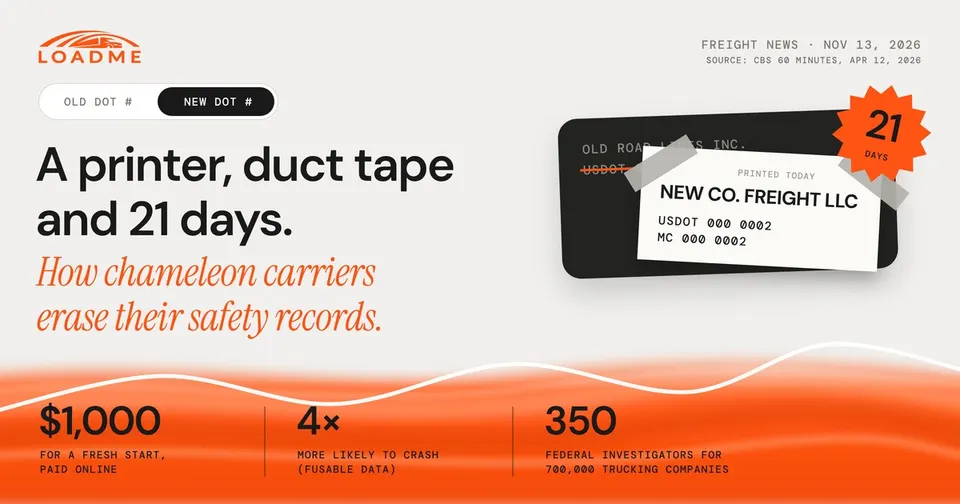
Daniel Sanchez had been driving commercial rigs for eight years when he was recruited in 2025 by a trucking network called Super Ego. What he says he saw there required no mechanic and no visit to a federal office. Documentation would arrive with a picture of a new company name and a new Department of Transportation number, he told 60 Minutes. "They'd have me print it out," he said, then buy some duct tape and "put it on the truck."
Nothing about the truck had changed except the paper on it. In his words, it was a "completely new truck at that point."
That account aired April 12 in an eight-month 60 Minutes investigation by correspondent Bill Whitaker into what the industry calls chameleon carriers: trucking operations that escape bad safety records by changing company names. The price of a fresh start, as trucking safety consultant Rob Carpenter described it on the broadcast, is $1,000, paid online. "And within 21 days, you have a trucking company," he said.
For shippers, the broadcast raises a practical question. If a safety history can be erased with a printer, a roll of tape and three weeks, what is a standard carrier check actually checking?
700,000 Trucking Companies, 350 Investigators
The scale of the oversight gap is easy to state. There are 700,000 trucking companies on American roads, 60 Minutes reported, and only 350 investigators at the Federal Motor Carrier Safety Administration to oversee them. That works out to one investigator for every 2,000 companies.
Carpenter, a trucker for 25 years who now tracks chameleon companies, said on the program that the general estimate is that "10% to 20% are operating somewhere in that spectrum of chameleon carrier."
The consequences are measured in crashes. Citing data gathered by Fusable, a risk assessment firm, the broadcast reported that chameleon carriers are four times more likely to be involved in a crash. It described the problem as an issue that contributed to the more than 5,300 truck-related deaths in 2024.
The mechanism is simple, which is why it works. A carrier accumulates violations under one name, then reappears under another. In one case the program showed in undercover video, it was the "same drivers, same trucks," with hundreds of violations erased by the switch of a carrier name and a Department of Transportation number.
To the people deciding whether to let a carrier haul their freight, the new entity looks spotless. "You're just a clean carrier to them," Carpenter said.
One Network, Almost 15,000 Violations
The broadcast's central case was a network called Super Ego Holding. Super Ego, 60 Minutes reported, was founded by Serbian entrepreneur Aleksandar Mimic and has grown into a sprawling enterprise. The broadcast identified Mimic only as the founder. According to Department of Transportation data cited in the report, chameleon carriers connected to Super Ego logged almost 15,000 safety violations and 500 accidents in the two years before the broadcast.
The program also showed a crash involving a school bus. A tractor-trailer tied to the network was traveling 72 miles an hour when it plowed into the bus, 60 Minutes reported, critically injuring two children.
Sanchez's account went beyond the taped-on numbers. The program reported that managers in Serbia would illegally reset federally mandated time clocks. Sanchez described it this way: "By the push of a button, I guess, somehow somewhere they have control of the app where they can just reset your time."
Super Ego Holding denies any wrongdoing, 60 Minutes reported. Company lawyers told the program that it is a leasing company, not a trucking firm, and that it is not responsible for the actions of affiliated carriers and drivers. At the time of the broadcast, the program said, the company was under federal investigation and named in a class action lawsuit, with more than 800 truckers suing it and affiliated companies for fraud and breach of contract.
The Front Door Problem
FMCSA Administrator Derek Barrs did not dispute the weakness. "We have a front door problem," he told Whitaker, meaning the agency needs to stop the practice before such carriers get into the system. The current registration system, he said, "is, like, 40 years old."
Barrs said the agency was trying to hire 40 additional investigators and would roll out a new registration system during the year. That work has since begun. In May, FMCSA started moving registration into a new system called Motus, which uses Login.gov and identity verification and which the agency describes as a step in its efforts to "strengthen oversight, reduce fraud."
A stronger front door helps. It does not answer the question a shipper faces at the loading dock: whether the truck backing in is run by the people, and carries the history, that the paperwork claims.
Four Things a New Number Cannot Change
A surface-level check asks questions of a USDOT number. Is the authority active? Is insurance on file? Is the safety record acceptable? A chameleon carrier is built to pass all three, because the number is new, the insurance is newly bought and the record is blank.
The checks that hold up are tied to things a new registration cannot change. There are four, and they work as a set.
1. The truck: a VIN outlives every USDOT number
A USDOT number belongs to a company, and a company can be abandoned. A vehicle identification number belongs to the tractor and stays with it for life. When the same VIN shows up under a carrier that has gone dark and again under one registered last month, that is the connection the name change was meant to cut.
In the 60 Minutes account, the trucks never changed. Only what was taped to them did.
2. The policy: insurance that is active today
The broadcast described carriers in these networks registering with the Department of Transportation and securing "minimal insurance." A certificate collected once at onboarding proves coverage on the day it was issued and nothing after.
The useful check reads the policy itself: the expiry date, the liability and cargo limits, and the named insured. Then it runs again before each load, because a file copy cannot show a policy that has lapsed or one written for a different company.
3. The person: identity behind the entity
Carpenter's description of online registration included a telling phrase: "say you are who you say you are." A company created that way is a name on a form. When the listed owner is a stand-in, known as a nominee, the people who ran the last carrier are invisible in the new one.
Matching a live face to a government-issued photo ID, for the person acting for the carrier and for each driver, ties the business to real people. It also gives a vetting system a way to notice when the same people return under another name.
4. The picture: what is physically on the truck
A sheet of paper taped to a truck is invisible in a database and obvious in a photograph. Current images of the tractor, its license plate and its permanent markings let a reviewer compare the physical truck with the equipment on file.
None of the four is decisive alone. The value is in the cross-reference: the same truck, the same policyholder, the same face or the same plate appearing where the paperwork says everything is new.
The Cost of Checking in Pieces
In much of the freight market, those four checks do not live in one place. Authority is looked up on a government website. Insurance arrives as an emailed certificate. Identity is a phone call and a signature. The truck is seen for the first time when it reaches the dock.
Each step is done once, often by different people, in systems that do not share what they find. A chameleon carrier depends on exactly that. Taken one at a time, every check passes.
Layers make it worse. When a load is posted on one board, covered through another party and handed to a truck the shipper never selected, the company that owns the freight is relying on a file it has not seen.
Size is no shield. The enterprise 60 Minutes examined had, the program reported, customers as large as national retailers and the United States Postal Service.
The alternative is a gate: a single system every carrier must pass before it can book, holding the truck, the policy, the person and the picture in one record and checking each against the others. A gate also has memory. The trucks, plates and people from a company that disappeared are still on file when they come back.
How LoadMe Puts the Four Checks in One Record
LoadMe was built as that kind of gate. It is a direct shipper-to-carrier freight marketplace, designed to remove traditional brokerage layers and to prevent fraud and double brokering. Only shippers can post loads, and every carrier is verified before it can book one.
Authority. LoadMe runs real-time FMCSA compliance checks, matching each carrier's USDOT number against FMCSA records for active authority and operating status. LoadMe staff approve, return or reject every carrier application.
Insurance. Carriers must hold at least $1 million in automobile liability and $100,000 in cargo coverage. The certificate is read for its expiry date, coverage minimums and named insured, and the check runs again on every booking. An expired policy blocks freight until a renewed certificate is verified.
Identity. The person acting for the carrier completes biometric identity verification through Persona, a liveness check that compares a selfie with a government-issued photo ID. Every driver on a load has completed identity verification and holds a verified license.
Equipment. LoadMe collects and reviews photos of each truck and its plate. A VIN or plate already registered to another company is flagged and held for review.
Once a load is moving, ELD integration and AI monitoring keep watch on it.
For shippers, the practical effect is that the work arrives done. A carrier that can book a load has already cleared the authority, insurance, identity and equipment checks in one place. There is no folder of certificates to assemble and no second system to reconcile.
That does not hand off a shipper's judgment. The shipper still chooses its carrier, and no screening system can promise that a bad actor never gets through. What a single gate changes is the odds: a carrier that returns with the same trucks, the same plates or the same people has to get past a system that has seen them before.
The truck Sanchez described became a new truck with a printout and a roll of tape. That works on a database that reads only the number on the door. It is much harder against a system that also looks at the truck, the policy and the person.
Sources
- The trucking companies evading federal safety enforcement and plaguing U.S. highways, CBS News, 60 Minutes, Bill Whitaker, April 12, 2026
- Motus: USDOT Registration System, Federal Motor Carrier Safety Administration, updated May 18, 2026
- Registration Resources Hub, Federal Motor Carrier Safety Administration
Note on sourcing: all figures, quotations and descriptions of the 60 Minutes investigation come from the CBS News transcript of the April 12, 2026 broadcast and reflect what was reported at that time. The ratio of investigators to trucking companies is a LoadMe calculation from the broadcast's figures. Descriptions of LoadMe's verification steps come from LoadMe.